
Blue Light Glasses: Do They Actually Work in 2026? A Clinical Review & Top 5 Picks
-
The promise vs. the symptom you're actually feeling
Why every patient who buys these arrives at my office with the same complaint — and what's really driving it. -
What the research actually says — a narrative review
The 2023 Cochrane review of 17 RCTs, the amber-lens sleep trials, and what survives honest scrutiny. -
The verdict — when blue light glasses help, when they don't
A clinical position on daytime eye strain vs. evening sleep use — separated cleanly. -
The top 5 of 15 evaluated — ranked
The lenses that filter what they claim to, in frames that hold up, at prices that aren't a tax on the placebo effect. -
What actually fixes screen-related eye pain
Computer Vision Syndrome, the 20-20-20 rule, blink rate, and the four-step setup fix that does more than any lens.
Every week I have at least one patient sit down, pull a pair of yellow-tinted glasses out of their bag, and ask me a version of the same question: "Are these doing anything?" They bought them because their eyes burn by 3 p.m. They bought them because their head aches after a long Zoom block. They bought them because someone on Instagram said blue light from their monitor was wrecking their retinas and their sleep and their mood, and a pair of glasses for thirty dollars was an easy thing to try.
Here's the honest answer, and I'll spend the rest of this article showing my work on it: for the daytime computer-eye-strain claim that 90% of buyers are trying to solve, the best evidence we have — including a 2023 Cochrane review of seventeen randomized controlled trials — says blue-light filtering lenses probably make no meaningful difference compared to standard clear lenses. For the evening "wear them two hours before bed to protect your sleep" claim, the picture is a little more interesting, but it's almost certainly not why you bought them.
And yet — a good pair isn't useless, and a bad pair is worse than nothing. I evaluated 15 of the most-purchased blue light glasses on the market and ranked the top 5 below. But the more important fix is the one no lens can give you, and it's at the bottom of this guide.
The Promise vs. the Symptom You're Actually Feeling
Almost everyone who walks into my office holding a pair of blue light glasses describes the same cluster of complaints: a dry, gritty burn behind the eyes by mid-afternoon; a dull pressure behind the brow; sometimes a tension headache that radiates from the base of the skull. They've connected the dots to "blue light from my screen" because that's what the marketing told them. The screen is the obvious culprit — it's right there, six hours a day, glowing at them.
But the screen isn't the problem. The way you're using the screen is.
Here's what's actually happening in your eyes during a long workday. You normally blink about 15 to 18 times per minute. When you're locked in on a monitor, that drops to 3 or 4. Your tear film evaporates. The cornea dries. The eye's accommodative muscles — the ones that focus the lens — are holding a near-point contraction for hours without relief. The lighting in your office is probably hitting your monitor at a glare angle. You haven't looked at anything more than 30 inches away in three hours. This is what hurts. It has a name in the literature: Computer Vision Syndrome (CVS), or digital eye strain.
The reason this matters: if you buy blue light glasses, feel modestly better, and stop digging — you've solved the wrong problem with the wrong tool, and the underlying drivers of your symptom keep grinding away. That's the pattern I see clinically, and it's why I wanted to write this guide the way I did.
What the Research Actually Says — A Narrative Review
The blue light glasses industry is now valued in the multiple billions of dollars and growing. Marketing claims fall into three broad categories: (1) they reduce digital eye strain during computer work, (2) they improve sleep quality when worn in the evening, and (3) they protect the retina from cumulative light-induced damage. The evidence base, when you actually sit down with it, looks very different from category to category.
The Cochrane review — the strongest evidence we have on daytime eye strain
In August 2023, a team based at the University of Melbourne, City University of London, and Monash University published a systematic review in the Cochrane Database of Systematic Reviews titled "Blue-light filtering spectacle lenses for visual performance, sleep, and macular health in adults." Cochrane reviews are widely considered the gold standard in evidence synthesis. This one pooled 17 randomized controlled trials. It is, at the moment, the most comprehensive evaluation of these lenses in existence.
The conclusion was direct: blue-light filtering lenses probably make no clinically meaningful difference to eye strain symptoms from computer use compared to non-filtering lenses, and there was no convincing evidence of benefit to sleep quality or retinal protection. The authors found no evidence of harm either — side effects were mild, infrequent, and similar to those reported with wearing any pair of glasses at all. The "probably" is doing real work in that sentence: the trials had methodological limitations the reviewers were careful to flag, including small sample sizes, short follow-up windows, and inconsistent measurements of light spectrum and exposure. But the direction of the evidence is consistent and the magnitude of any benefit, if it exists at all, appears small.
A 2018 survey of Australian optometrists found that 75% prescribed blue-light filtering lenses to patients despite acknowledging the evidence was limited. The Cochrane authors flagged this gap between prescribing practice and supporting evidence as one of the reasons the review was needed in the first place.
The amber-lens sleep studies — a different category entirely
Where the picture changes is in evening use of amber-tinted lenses — not the lightly tinted "clear" lenses sold for daytime computer use. A 2018 randomized crossover trial led by Ari Shechter at Columbia, published in the Journal of Psychiatric Research, recruited 14 adults with insomnia diagnoses and had them wear amber wrap-around lenses (blocking ~97% of blue wavelengths) versus clear placebo lenses for two hours before bed across seven nights. The amber-lens condition produced significantly improved subjective sleep quality, longer reported sleep duration, and ~30 minutes more actigraphy-measured total sleep time. A 2009 trial by Burkhart and Phelps using amber safety glasses worn three hours before bed found similar improvements. Smaller lab studies have measured 50%+ increases in nocturnal melatonin secretion in amber-lens conditions compared to controls.
These trials are small. Sample sizes are typically under 30. The populations were people with insomnia, not healthy controls. The lenses used were aggressive amber filters cutting most of the 400–500 nm range — not the subtle, near-clear filters sold as "blue light glasses" at most retailers. But the signal is there and it is biologically plausible: blue wavelengths in the 460–480 nm range are the most potent suppressors of melatonin, and physically removing them in the hours before bed produces measurable circadian effects.
Retinal protection — the weakest claim
The third marketing claim — that blue light from screens damages the retina over time — has the thinnest support. No included Cochrane trial evaluated retinal outcomes. The blue light emitted by consumer screens is several orders of magnitude lower in intensity than the blue light naturally received from a few minutes of midday sunlight, which the human retina is evolved to tolerate. Major ophthalmology bodies — including the American Academy of Ophthalmology — have stated publicly that they do not recommend blue light glasses for retinal protection. There simply is no body of evidence supporting that claim.
So when you stack all three: daytime eye strain — probably no benefit; evening sleep with aggressive amber lenses worn 2–3 hours before bed — modest benefit, mostly in people already struggling with sleep; retinal protection — no credible evidence at all.
The Verdict — Tech Neck, Eye Burn, and the Honest Recommendation
Here's my position as a clinician who sees this complaint constantly.
If you're buying blue light glasses to fix screen-induced eye strain during the workday: the lenses themselves are not going to solve it. They might produce a modest placebo effect — which is real and not nothing — but they are not addressing the mechanism. What you actually need is the fix at the bottom of this guide: blink-rate restoration, the 20-20-20 rule, glare control, and a proper viewing distance and monitor height. A pair of glasses is not a substitute for any of those.
If you're buying them for evening sleep protection: the evidence is more interesting, but most products on the market aren't right for the job. Daytime "blue light" glasses with very slight tints are filtering perhaps 10–25% of blue light. The amber lenses in the sleep trials were filtering 90%+. If sleep is your real goal, you want aggressive amber or even orange-tinted lenses worn 2 to 3 hours before bed — and even then, the much simpler intervention of putting your phone down an hour before bed will usually outperform the glasses. Of the products in this guide, the GUNNAR Intercept (#2) is the only one with a meaningful amber tint, and the Gaoye 2-pack and Gunnar Intercept are the only options I'd consider for nighttime use specifically.
If you wear glasses anyway and the prescription doesn't cost you more: there's no harm in adding a blue-light filter coating. It's not going to help much, but the Cochrane review didn't find harm either. The cost-of-acquisition calculation matters more than the lens itself.
I evaluated 15 of the most-purchased blue light glasses against the same 11-dimension framework I use for every product on this site. None of them scored above a 7.0 — none cracked the "DeskDoctor Recommended" threshold. That's not a knock on any single brand; it reflects the underlying reality that the category itself has a ceiling. The lenses that do their job adequately (they do filter what they claim to filter, in frames that hold up) are listed below, ranked. Beyond the top 5, the remaining 10 are listed in the FAQ at the bottom.
The Top 5 of 15 Evaluated — Ranked
These are the only five from my evaluation that I'd hand to a patient with a clear conscience. Every one scored in the "Meets Minimum Clinical Standard" tier (5.0–6.9). None reached "DeskDoctor Recommended." That ceiling is honest — and it reflects the category, not the products. Tap any scorecard to see the full 11-dimension breakdown.
Prospek Blue Light Blocking Glasses

If you're going to buy a pair of blue light glasses despite everything I said above — and many of my patients do, because the placebo is comforting and the frames are unobtrusive enough to wear all day — this is the pair I'd point you to. Prospek's filtration spec is one of the few in the category that's actually published and verifiable, the anti-glare coating helps with the real problem (monitor reflections), and the frame holds up to daily handling.
- Published filtration spec — verifiable
- Solid anti-glare coating
- Good user reliability signal
- Clear tint — limited evening use
- Priced above category median
- One-size frame limits fit range
GUNNAR Intercept Computer Glasses
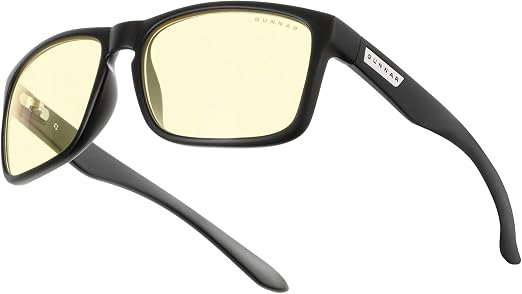
This is the only pair on the list with an amber tint aggressive enough to plausibly intersect the evening sleep evidence I covered above. If you're using glasses 1–2 hours before bed to reduce melatonin suppression from your phone or TV, the GUNNAR Intercept is the right tool for that job — not for daytime work, where the amber color shift gets in the way.
- Real amber tint — useful for sleep use
- Solid frame construction
- Strong user reliability signal
- Amber shift unwelcome for daytime color work
- No third-party filtration certification
- Designed for gaming aesthetic, not all faces
Baxter Blue Lane Blue Light Glasses

If you'd actually wear these around the office and into a meeting, the Baxter frame is the most considered piece of design in the category — acetate, properly weighted, looks like a normal pair of frames rather than a piece of safety equipment. The lens filtration is in line with the rest of the clear-tint pack, which is to say: modest.
- Strongest filtration of the clear-lens picks
- Genuinely good-looking acetate frames
- Wearable in any professional setting
- Priced 40–60% above category median
- Insufficient review volume to verify reliability
- Single frame size limits fit range
Warby Parker Blue Light Filtering Glasses
If you already wear prescription glasses, this is the only one of the top 5 where adding a blue-light filter is essentially free of trade-offs — you were buying frames anyway, and the upcharge for the coating is small. The lenses themselves filter less than the clinical-grade options above, but that's a fair trade for being able to actually see clearly.
- Available with full prescription
- Wide range of frames to fit any face
- Solid customer service infrastructure
- Premium pricing — well above category median
- Lower filtration than category specialists
- Insufficient review volume on filter coating
Felix Gray Nash

Felix Gray sits in the middle of the pack on every dimension that matters — frame quality is real, the lens does what it claims, and the filtration is modest but published. If you don't want to think about it too hard and you want a frame that looks normal in a video call, this is a defensible pick.
- Genuinely good frame design
- Looks normal on camera
- Sleep variant available for evening
- Only ~15% filtration — the lowest of the top 5
- Priced above category median
- No published third-party certification
What Actually Fixes Screen-Related Eye Pain
If you've made it this far, you understand that the real cause of the symptoms most people are trying to solve with blue light glasses is Computer Vision Syndrome — and that no lens addresses it directly. Below is the protocol I walk patients through. It costs nothing, takes about fifteen minutes to set up, and outperforms any pair of glasses I've ever measured.
- Set your monitor at arm's length, top edge at or just below eye level. 20 to 28 inches from your face. The top of the screen should sit a few degrees below your horizontal line of sight, so your eye is angled slightly downward — this is the natural resting position of the eyelid and tear film.
- Apply the 20-20-20 rule. Every 20 minutes, look at something 20 feet away for 20 seconds. This breaks the accommodative contraction in the focusing muscles and is the single best-supported intervention for digital eye strain.
- Restore your blink rate consciously, for the first few days. Your blink rate drops from ~15/min to ~3–4/min on a screen. Just thinking about blinking once a minute or so, deliberately, restores the tear film and stops the dry-eye burn.
- Kill the glare on your monitor. Reposition the screen perpendicular to your window, not facing it or back-to it. Switch overhead fluorescents off if they're hitting the screen. This is what an anti-glare coating on a pair of glasses is trying to fix — but it's much more effective to fix the environment than the eyewear.
- Match your monitor's brightness to your room. If your screen is dramatically brighter than the wall behind it, your eyes are constantly readjusting. Drop the monitor brightness until it roughly matches the ambient light. Enable automatic brightness if your OS supports it.
- Use a real warm-light setting after sunset. Both macOS (Night Shift) and Windows (Night Light) ship with built-in warm-shift modes that genuinely reduce the blue wavelength reaching your eye. They cost nothing, they work, and the evidence base — including the amber-lens trials I reviewed above — supports them more directly than any pair of glasses.
If you do all six and the symptom doesn't resolve within two weeks, you're not dealing with simple digital eye strain. See an optometrist.
Computer Vision Syndrome
Dry, burning eyes by mid-afternoon. Blurred vision when shifting focus from screen to distance. Headache behind the brow.
Fix: 20-20-20 rule, restored blink rate, proper monitor height & viewing distance.
Glare-Triggered Tension Headache
Pressure across the temples and forehead that builds throughout the workday. Squinting at the screen.
Fix: reposition monitor perpendicular to windows; reduce overhead lighting hitting the screen.
Evening Sleep Disruption
Trouble falling asleep after late-evening screen time. Feeling wired despite being physically tired.
Fix: warm-shift mode after sunset, screens away one hour before bed, or amber-lens glasses 2 hours before bed for resistant cases.
- 5.9 Benicci Blue Light Protection Computer Glasses — strong Layer III value but low filtration scores.
- 5.9 Livho High Tech Blue Light Glasses — excellent value tier, modest filtration.
- 5.9 J+S Vision Blue Light Shield Glasses — high reliability signal, weak filtration.
- 5.9 Peepers Clark Focus Blue Light Glasses — decent frame, weaker warranty signal.
- 5.8 Gaoye Blue Light Blocking Glasses (2-pack, TR90) — only other tinted option in the field; best-in-class value.
- 5.8 Cyxus Blue Light Blocking Computer Glasses — competitive pricing, baseline filtration.
- 5.8 ANYLUV Blue Light Glasses Metal Frame — metal frame is a fit-range trade-off.
- 5.8 Gamma Ray Optix Blue Light Blocking Glasses — solid reliability, weakest filtration scores.
- 5.6 TIJN Blue Light Blocking Glasses (Clear Frame Square) — frame design above the filtration spec.
- 5.4 ANRRI Blue Light Blocking Glasses — weakest filtration in the field; included for completeness.
Take the DeskDoctor Virtual Assessment
If your eyes are burning at 3 p.m. and you can't tell whether it's the screen, the lighting, your viewing distance, or something else entirely — the free virtual assessment delivers a personalized setup plan, recovery guide, and equipment matches in about 12 minutes.
Take the Free Assessment →Affiliate Disclosure: DeskDoctor participates in affiliate programs including the Amazon Associates Program. We may earn a commission on qualifying purchases made through links in this article at no additional cost to you. Editorial selection and DEAS scoring are independent of affiliate relationships.
Clinical Disclaimer: This article is for educational purposes only and does not constitute medical advice. Persistent eye discomfort, headache, vision changes, or sleep disturbance should be evaluated by a qualified optometrist, ophthalmologist, or physician. Do not use the information here as a substitute for professional medical care.
0 Comments