
The 10 Best Anti-Fatigue Mats of 2026
Here's what I see all the time: someone buys a standing desk, stands on a bare hardwood or tile floor, and within about ninety minutes their feet are burning, their calves feel tight, and their lower back is aching worse than it ever did sitting. They blame the standing desk. The standing desk isn't the problem. The floor is.
When you stand still on a hard surface, your leg muscles lock up and blood starts pooling in your lower legs instead of circulating. That's the burning, heavy-legs feeling, and it's why most people quietly stop using the standing desk they spent good money on. A decent anti-fatigue mat fixes it by giving your feet a slightly unstable, cushioned surface that keeps you making tiny weight shifts all day — which is exactly what keeps the blood moving.
I reviewed 20 mats for this guide and these are the 10 I'd actually put a patient on. They split into three honest groups: a couple of genuinely excellent active-standing mats at the top, a solid tier of well-built foam mats in the middle, and budget options that do the basic job without pretending to be more. None of them are miracle products — a mat buys you more comfortable time on your feet, it doesn't replace moving. Here's how they ranked.
Ergodriven Topo Not Flat Standing Desk Mat
The sculpted "not flat" terrain gives your feet places to stretch and shift, so you keep moving without thinking about it. It scored highest in this group for fatigue reduction.
Read review ↓ComfiLife Anti-Fatigue Floor Mat (3/4")
A simple, high-density 3/4-inch foam mat that hits the thickness sweet spot most experts recommend. You pay the least here for a mat that genuinely holds its support.
Read review ↓Imprint CumulusPro Commercial Anti-Fatigue Mat
Built to commercial standards with the strongest certification in this guide. If you stand for long shifts and want a mat that won't bottom out in a year, this is it.
Read review ↓| # | Mat | DEAS | Best For |
|---|---|---|---|
| 1 | Ergodriven Topo Not Flat | 7.6 | Active standers |
| 2 | Imprint CumulusPro Commercial | 7.4 | Long shifts |
| 3 | WellnessMats Original Collection | 7.3 | Lifetime buy |
| 4 | ComfiLife 3/4-inch | 6.9 | Budget pick |
| 5 | NoTrax Cushion Trax Industrial | 6.9 | Garage / shop |
| 6 | Gorilla Grip Comfort Mat | 6.8 | Compact spaces |
| 7 | Sky Solutions Floor Mat | 6.8 | Value runner-up |
| 8 | GelPro NewLife Eco Pro | 6.8 | Softer feel |
| 9 | Fellowes Wellness Mat | 6.8 | Office standard |
| 10 | FEATOL Extra Thick (9/10") | 6.7 | Maximum cushion |
Why your feet and lower back hurt at a standing desk
Standing burns roughly 20% more energy than sitting, and most of that cost lands on your lower limbs. Research on prolonged standing is consistent: discomfort in the legs and lower back can set in within about 90 minutes on a hard floor, driven by reduced circulation and the steady, unchanging load on your joints. A cushioned surface interrupts that by spreading your weight over a larger contact area and nudging you into the constant micro-movements that keep blood flowing. That's the whole mechanism — everything below is about which mats deliver it best.
1. Ergodriven Topo Not Flat Standing Desk Mat

This is the mat I reach for first with patients who fidget — the raised mounds and calf-stretch points give your feet somewhere to go, so you keep shifting weight instead of locking up. If your standing desk sessions die after twenty minutes because your feet go numb, the terrain on this one is what keeps you up there.
Pros
- Sculpted surface drives constant micro-movement
- Calf and arch stretch points built in
- Firm enough that you never sink and bottom out
Cons
- Smaller footprint than flat mats
- Terrain feel takes a day or two to get used to
- Not ideal if you also want a kitchen mat
2. Imprint CumulusPro Commercial Anti-Fatigue Mat

If you stand for genuinely long stretches and you're tired of replacing cheap mats every year, this is the one built to outlast them. It's the most credibly constructed mat in the group, and the cushioning still holds its support under all-day load instead of going flat.
Pros
- Best-documented certification of any mat here
- Commercial-grade build holds up to long-shift use
- Thick, supportive cushion that resists bottoming out
Cons
- Among the pricier picks
- Heavier and harder to move between rooms
- Plain look won't suit every space
3. WellnessMats Original Collection Anti-Fatigue Mat

This is the mat you buy once and stop thinking about — the warranty is the longest in this guide for a reason, and the one-piece construction means there's no top layer to peel or tear. If you want a permanent fixture under your desk rather than a consumable, pay up for this one.
Pros
- Longest warranty in the guide by a wide margin
- Single-piece build won't delaminate or curl
- Easy to wipe clean, holds up for years
Cons
- Highest price tier here
- Firmer feel than plush foam mats
- Limited size and color options
4. ComfiLife Anti-Fatigue Floor Mat (3/4")

For most people setting up their first standing desk, this is where I'd start — it lands right in the 3/4-inch thickness range experts point to as the balance of cushion and stability, and it costs the least of anything I'd recommend. It does the core job well and doesn't pretend to be more.
Pros
- Hits the expert-recommended 3/4-inch thickness
- Lowest price of any mat I'd recommend
- High-density core holds support better than bargain foam
Cons
- No third-party ergonomic certification
- Memory foam attracts dust and shows wear
- Single flat surface — no movement prompts
5. NoTrax Cushion Trax Industrial Anti-Fatigue Mat
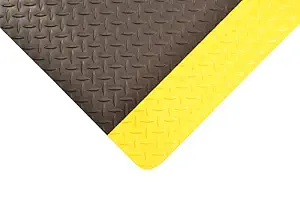
This is the one I'd put in a garage, workshop, or anywhere the floor sees spills and grit — the tough vinyl top shrugs off abuse that would chew up a foam mat. It's firmer underfoot than the foam picks, so it's about durability and grip more than plush comfort.
Pros
- Industrial vinyl top survives spills and debris
- Excellent traction on slick floors
- Will outlast foam mats in rough environments
Cons
- Firmer, less cushioned feel
- Looks industrial, not home-office
- Heavier to reposition
6. Gorilla Grip Anti-Fatigue Comfort Mat

A reliable, well-priced foam mat that fits tight setups where a full-size mat won't — it's the one I suggest when someone's desk is wedged into a corner. The comfort is solid for the money; it just doesn't do anything to keep you moving.
Pros
- Compact footprint fits small workspaces
- Waterproof, easy-clean surface
- Strong value for a basic foam mat
Cons
- No independent certification
- Flat surface offers no movement cue
- Smaller size won't suit wide stances
7. Sky Solutions Anti-Fatigue Floor Mat

Essentially the value runner-up — a clean, larger 3/4-inch foam mat that gives you more room to shift your stance than the compact options. If the ComfiLife is sold out or you want extra surface area, this is the easy swap.
Pros
- Generous surface for a wider stance
- Solid high-density foam at a fair price
- Good non-slip backing
Cons
- No ergonomic certification
- No terrain or movement prompts
- Edges can lift on thick carpet
8. GelPro NewLife Eco Pro Anti-Fatigue Mat

This one's for people who want a plusher, more giving surface under their feet — it feels softer than the firm foam picks. That softness is the trade-off: lovely for shorter stints, less stable for a full standing day.
Pros
- Noticeably softer, cushioned feel
- Comfortable for shorter standing sessions
- Clean look that suits a home office
Cons
- Softer surface is less stable for all-day standing
- Mid-pack value for the price
- Can feel like you sink if you stand still too long
9. Fellowes Anti-Fatigue Wellness Mat

The safe, no-surprises office pick — if your workplace already buys Fellowes gear and you want something predictable, this delivers standard cushion and a clean profile. It's competent across the board without standing out anywhere.
Pros
- Reliable, predictable office-grade comfort
- Clean, professional appearance
- Easy to source through office suppliers
Cons
- No third-party certification
- Nothing here beats cheaper foam mats on comfort
- Flat surface, no movement benefit
10. FEATOL Extra Thick Anti-Fatigue Standing Mat (9/10")
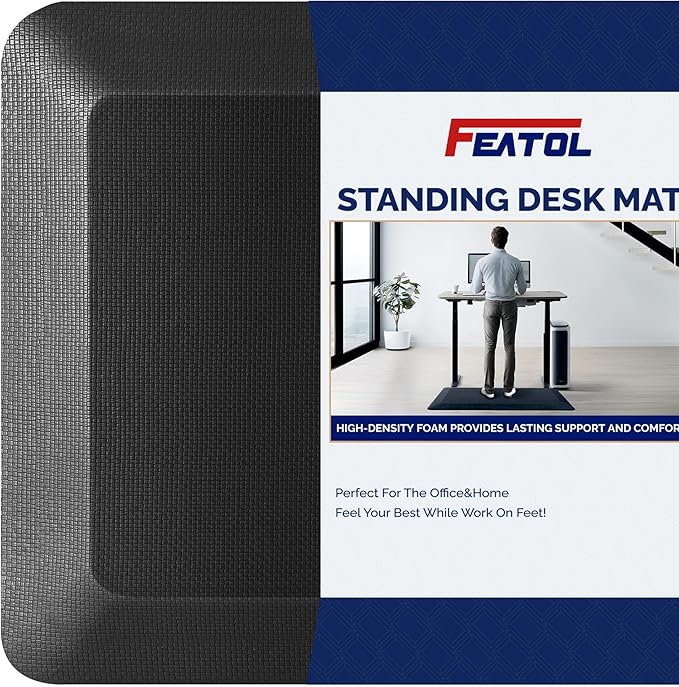
If you specifically want the deepest, softest cushion you can get, this near-inch-thick mat delivers it — people with sensitive feet or existing foot pain often prefer the extra give. Just know that more thickness means slightly less stability, so it's a comfort-first, not a balance-first, choice.
Pros
- Deepest cushion in the guide
- Great for sensitive or already-sore feet
- Plush feel right out of the box
Cons
- Extra height reduces standing stability
- No independent certification
- Thick foam can compress over heavy use
- Set the desk so your elbows rest at about 90 degrees with your forearms parallel to the floor. The mat won't fix a desk that's too high or too low.
- Position your screen so the top of it sits at or just below eye level — standing tends to drop your gaze, and a low monitor pulls your neck forward.
- Place the mat directly where your feet land, centered under the keyboard, not pushed back toward the desk legs.
- Stand with your weight even across both feet, knees soft and unlocked. Locked knees cancel out most of what a mat does for circulation.
- Shift your stance every few minutes — rock heel to toe, stretch a calf, step side to side. The mat makes this easy; your job is to actually do it.
- Alternate sitting and standing rather than standing all day. Aim to start with 20–30 minute standing blocks and build up as your legs adapt.
Burning, aching feet
Heavy, tight calves & legs
Lower-back ache while standing
What should I look for when buying an anti-fatigue mat?
Four things, in order. First, thickness — around 3/4 inch is the range most ergonomists point to as the balance between cushion and stability; thinner mats bottom out, much thicker ones get wobbly. Second, foam density — a high-density core keeps its support, while cheap low-density foam compresses flat within weeks. Third, beveled edges and a non-slip base, so you don't trip on the mat or have it slide out from under you. Fourth, the surface: a flat mat is fine, but a sculpted or textured top actively prompts the small weight shifts that fight fatigue.
How thick should an anti-fatigue mat be?
For desk standing, about 3/4 inch is the sweet spot. It gives enough cushion to take the impact off your heels and arches without making the surface so soft that your balance suffers. Extra-thick mats near a full inch feel plusher and suit people with already-sore feet, but the added height costs you a little stability. Below roughly half an inch, you lose most of the fatigue-reducing benefit.
Do anti-fatigue mats actually help with back pain from standing?
For standing-related lower-back discomfort, yes — and the mechanism is well understood. Standing still on a hard floor loads your joints continuously and slows circulation in your legs, and that strain travels up into your lower back. A cushioned surface that keeps you making small movements eases both. What a mat won't fix is back pain caused by a badly set-up desk or monitor; if your screen is too low or your desk height is wrong, address that first.
Will a mat let me stand all day without problems?
No, and I'd be wary of any product that claims it does. A good mat buys you more comfortable time on your feet, but the body isn't built for static standing any more than it's built for static sitting. The healthiest pattern is alternating — sit, stand, move — with the mat making your standing blocks more comfortable. Treat it as one piece of the setup, not the whole answer.
Which mats did you review but not include in the top 10?
I reviewed 20 mats in total for this guide. The 10 that didn't make the featured list still scored respectably and may suit specific needs: Kangaroo Ergonomic Anti-Fatigue Mat (DEAS 6.7), iPrimio Extra Thick Standing Mat (6.7), KMAT Cushioned Kitchen Mat (6.4), HEALEG Extra Thick Mat (6.4), StepRite Cushioned Kitchen Mat (6.4), WISELIFE Cushioned Kitchen Mat (6.4), KitchenClouds Cushioned Rug (6.3), HappyTrends Cushioned Floor Mat (6.3), Wearwell Diamond Plate SpongeCote (6.3), and the Amazon Basics Standing Comfort Mat (6.1). Most of these are perfectly serviceable kitchen-grade mats; they ranked lower mainly on construction quality, certification, or long-term support compared with the featured picks.
Take the DeskDoctor Virtual Assessment
A mat is one piece of a standing setup. If your feet, legs, or back still hurt and you can't tell whether it's the floor, the desk height, or your monitor, the free virtual assessment delivers a personalized setup plan, recovery guide, and equipment matches in about 12 minutes.
Take the Free Assessment →Affiliate disclosure: DeskDoctor participates in the Amazon Associates Program. We may earn a commission on qualifying purchases made through links on this page, at no extra cost to you. Product selections and DEAS scores are determined independently and are never influenced by affiliate relationships.
Clinical disclaimer: This article is for general educational purposes and does not constitute medical advice. AJ Prince, HEAS, is a Healthcare Ergonomic Assessment Specialist, not a physician. If you have persistent or worsening pain, consult a qualified healthcare provider before making changes to your setup or routine.
0 Comments