Best Ergonomic Footrests 2026: Ranked by a Certified HEAS After 1,000+ Assessments
A footrest is one of the least glamorous ergonomic purchases you can make — which is exactly why so many people get it wrong. Most buyers think a footrest solves one problem: tired feet. In clinical practice, it solves a different one. When a seat height is set to accommodate keyboard and screen geometry, the majority of users — especially those under 5'7" — find their feet either dangling or barely touching the floor. That changes popliteal pressure, shifts the pelvis posteriorly, and loads the lumbar spine in ways that no lumbar support can fully compensate for. A footrest doesn't just support your feet; it makes the rest of your ergonomic setup work.
The market is flooded with options ranging from $15 foam blocks to $150 motion platforms. After applying the DeskDoctor Ergonomic Assessment Scoring (DEAS) methodology to 20 products and drawing on patterns observed across thousands of workstation evaluations at Loma Linda University Health, the top pick is the Humanscale FR300 Foot Rocker (DEAS 7.1) — the only product in this review that treats dynamic movement as a clinical feature rather than a marketing angle. For most users not committed to active movement, the ErgoFoam Adjustable Foot Rest (DEAS 7.0) is the better daily-use value.
If you're unsure whether you actually need a footrest, here's a quick self-check: sit at your workstation with your chair at the height that keeps your elbows near 90° at the keyboard. If your feet are flat on the floor without pressing your thighs upward — you likely don't need one. If there's a gap, or if you find yourself crossing your legs, tucking feet under the chair, or perching on the front edge of the seat to reach the floor — a footrest will make a measurable difference in your comfort and long-term musculoskeletal health.
All 10 Footrests Ranked: DEAS Scores at a Glance
| # | Footrest | DEAS | Best For |
|---|---|---|---|
| 1 | Humanscale FR300 Foot Rocker | 7.1 | Active Movement |
| 2 | Humanscale FR500 Foot Rocker | 7.0 | Active + Taller Users |
| 3 | ErgoFoam Adjustable Foot Rest | 7.0 | Best Value Passive |
| 4 | HUANUO Adjustable Footrest | 6.5 | Budget Adjustable |
| 4 | 3M Adjustable Footrest | 6.5 | Office / Corporate |
| 6 | UPLIFT Desk Footrest | 6.3 | Standing Desk Pairing |
| 7 | Everlasting Comfort Memory Foam | 6.2 | Soft Passive Support |
| 7 | Eureka Ergonomic Tilt Adjustable | 6.2 | Tilt Adjustment |
| 9 | Cushion Lab Ergonomic Footrest | 6.1 | Comfort / Recovery |
| 10 | ComfiLife Memory Foam Foot Rest | 6.0 | Entry-Level Foam |
Why Trust This Guide
Every product in this guide is evaluated using the DeskDoctor Ergonomic Assessment Scoring (DEAS) framework — a structured 11-dimension rubric weighted across three clinical layers: performance (50%), quality (30%), and market value (20%). DEAS scores are calculated, not assigned. Each dimension maps directly to an anchor in the rubric, and all scoring rationale is documented transparently in each product's review.
As a Healthcare Ergonomic Assessment Specialist (HEAS) at Loma Linda University Health, I conduct over 1,000 formal workstation assessments annually across clinical, administrative, and research environments. Footrest recommendations are among the most frequent clinical interventions I make — because seat-to-floor height mismatches affect a larger portion of the seated workforce than most ergonomics guides acknowledge.
DeskDoctor earns affiliate revenue when readers purchase through our links. This does not influence scoring — all DEAS scores are calculated before any affiliate relationship is established. Products that score below a clinical threshold are excluded from the "recommended" tier regardless of affiliate availability. The scoring rubric and weights are published on the methodology page at mydeskdoctor.com.
The Case for Getting This Right
Dangling feet aren't just uncomfortable — they create a predictable chain of biomechanical consequences. Popliteal pressure increases, venous return decreases, and the pelvis tilts posteriorly. The lumbar spine then compensates with flexion, and the cascade continues upward. A well-chosen footrest interrupts this chain at its origin, making downstream interventions — lumbar supports, seat cushions, monitor arms — more effective by giving the body a stable, correctly positioned foundation.
How We Score: The DEAS Framework
Five dimensions measuring how well a footrest supports neutral joint position, provides adjustability, reduces injury risk, accommodates diverse users, and performs its core category function — specifically, popliteal angle correction and pressure distribution. This layer carries the most weight because a comfortable footrest that fails clinically is not a good ergonomic tool.
Four dimensions covering material construction, published certifications, warranty relative to the category benchmark (1 year for footrests), and verified user reliability from Amazon review data (minimum 50 reviews required). Quality underpins durability — a footrest that fails within a year offers no long-term clinical value.
Two dimensions benchmarked against the footrest category median of $35 on Amazon. A product doesn't need to be cheap to score well here — it needs its clinical performance to justify its price. Products that deliver above-average clinical outcomes at or below benchmark earn the highest value scores.
The Reviews
Humanscale FR300 Foot Rocker
The FR300's defining clinical feature isn't what it supports — it's what it allows. Where every other footrest in this guide is a static platform, the FR300 is a dynamic system. The rocker mechanism enables continuous, low-amplitude dorsiflexion and plantarflexion throughout the workday, and this isn't a gimmick: passive calf muscle activation improves venous return and reduces the pooling and lower-extremity fatigue associated with extended seated posture. For users without access to a standing desk or treadmill, this is the closest seated-workstation equivalent to low-level movement.
The FR300's Neutral Posture Support score of 8 reflects real clinical breadth. The rocking geometry keeps the ankle in a dynamically centered position rather than a fixed angle, which is more forgiving of individual variation than a static platform with a locked tilt. Users from roughly the 10th through 90th height percentile can achieve appropriate knee flexion with the FR300 — though the Adjustability Range score of 7 signals one legitimate limitation: height adjustment is present but not granular. Users at the 5th percentile (approximately 5'0") may find themselves between ideal settings, which is why the FR500 warrants consideration for shorter users who want more precise height control.
Material and construction score a 9 — the highest in this category. Humanscale builds the FR300 with the same manufacturing standard as its seating line: stable base, non-slip surface, and rocker mechanism designed for daily commercial use. The 1-year warranty matches the category benchmark, leaving room for Humanscale to differentiate with longer coverage on a premium product. Verified user reliability earns a 6, which reflects adequate but not exceptional long-term ratings — a function of the niche market position rather than product failure patterns.
The price positions the FR300 above the $35 benchmark — meaningfully so. Its value score reflects that a premium is present, but not disproportionate given the clinical differentiation. For the subset of users who genuinely benefit from dynamic foot positioning — those with chronic lower-extremity fatigue, varicose vein history, or high-sedentary-hour workloads — the FR300 is not overpriced. For users who simply need their feet off the floor while typing, it may be more than necessary.
- Only dynamic/rocking footrest in recommended tier
- Promotes active calf engagement and venous return
- Commercial-grade construction (highest II.1 in category)
- Broad population accommodation (10th–90th percentile)
- Priced significantly above the $35 category benchmark
- No published ergonomic or third-party certification
- Rocking may distract users who prefer static support
- Height adjustment less granular than static competitors
Humanscale FR500 Foot Rocker
The FR500 is the FR300's larger sibling — same dynamic rocking concept, larger platform footprint. Where the FR300 scores equally or higher across most dimensions, the FR500's slightly lower Adjustability Range score (6 vs 7) reflects a narrower fit for users at smaller stature. Counterintuitively, the larger platform can work against short-statured users whose seated foot positioning doesn't span the full surface, reducing the effective dynamic range of the rocker at lower heights.
For taller users — particularly those above 5'9" — the FR500's expanded surface area is a meaningful upgrade. Larger feet and wider stance widths are better accommodated, and the stability profile under load is marginally better than the FR300. If you're choosing between the two, the decision is straightforward: FR300 for users under 5'8", FR500 for those above it.
Population Accommodation and Verified User Reliability scores both drop one point relative to the FR300 (5 and 5 respectively), reflecting the same niche market size and the slightly narrower effective user range. Price premium remains, with the same value tier as the FR300. For users who fit the profile, the FR500 earns its place — but it should be selected intentionally, not by default.
- Larger platform suits users 5'9" and above
- Same clinical dynamic rocking benefit as FR300
- Commercial-grade Humanscale construction
- Less effective for users under 5'7"
- No certification; above-benchmark price
- Narrower fit range than FR300 for general population
ErgoFoam Adjustable Foot Rest
ErgoFoam earns its "best value" designation through a specific combination that is harder to achieve than it sounds: genuinely good foam density paired with verifiable user satisfaction at a price at or near the category benchmark. Most foam footrests either use under-density material that compresses quickly into clinical irrelevance, or over-density material that provides pressure without any compliance. ErgoFoam's material construction scores a 7 — not because the foam is exotic, but because it gets the density right. The surface remains supportive after extended use in a way that cheaper competitors don't sustain past the first month of daily use.
The Verified User Reliability score of 9 is the highest in this guide and deserves weight. With a substantial Amazon review base rating consistently above the 4.2 footrest category average — and without the typical durability complaints that appear in competing foam products — ErgoFoam's long-term field performance is the strongest evidence available for a product in this price tier. DEAS does not substitute manufacturer claims for user data, and the data here is unambiguous.
Where ErgoFoam limits itself is adjustability. The score of 6 reflects height adjustability that covers the average user well but falls short at population extremes. The product does not provide angle adjustment independent of height, which constrains users whose ideal ankle position isn't at the standard 15° tilt. For the majority of users — those between 5'3" and 5'9" seeking straightforward floor-to-foot contact without dynamic movement — this is not a clinical compromise. For those with specific plantarflexion or dorsiflexion requirements, the HUANUO or 3M offer more angular control.
- Highest verified user reliability in this guide (II.4: 9)
- Correct foam density — doesn't compress flat over time
- At-benchmark pricing with above-average clinical performance
- Height adjustable via removable cover layer
- No independent angle adjustment
- No published ergonomic certification
- Less effective for users requiring extreme height adjustment
HUANUO Adjustable Footrest
The HUANUO earns its position as the best budget-tier pick by delivering something almost every competitor at this price sacrifices: genuine height and angle adjustment in a single unit. Where most entry-level footrests offer a fixed platform at a fixed angle, the HUANUO provides both axes of adjustment — and this matters clinically. Height without angle control means a user who needs more lift but a neutral ankle position is stuck choosing between popliteal support and ankle alignment. The HUANUO avoids this forced tradeoff.
The clinical performance scores are solidly in the "meets minimum standard" range (I.1: 7, I.5: 6). The product achieves neutral posture for the average user and provides adequate popliteal correction for users in the mid-stature range. Population accommodation drops a point relative to premium products — no published capacity beyond standard, and the platform size is modest for users with wider stance widths. For most office workers seeking their first ergonomic footrest, none of this is a disqualifying limitation.
The price-to-performance ratio is where the HUANUO earns its strongest DEAS contribution. At the category benchmark and below, it delivers adjustability that footrests at twice its price sometimes don't offer. The Ergonomic Value Ratio of 7 confirms this — genuinely good value for the clinical features delivered.
- Height AND angle adjustment at budget price
- Strong verified user reliability (II.4: 8)
- At or below $35 benchmark
- Construction quality drops at this price tier (II.1: 5)
- No published certifications
- Not ideal for users outside mid-stature range
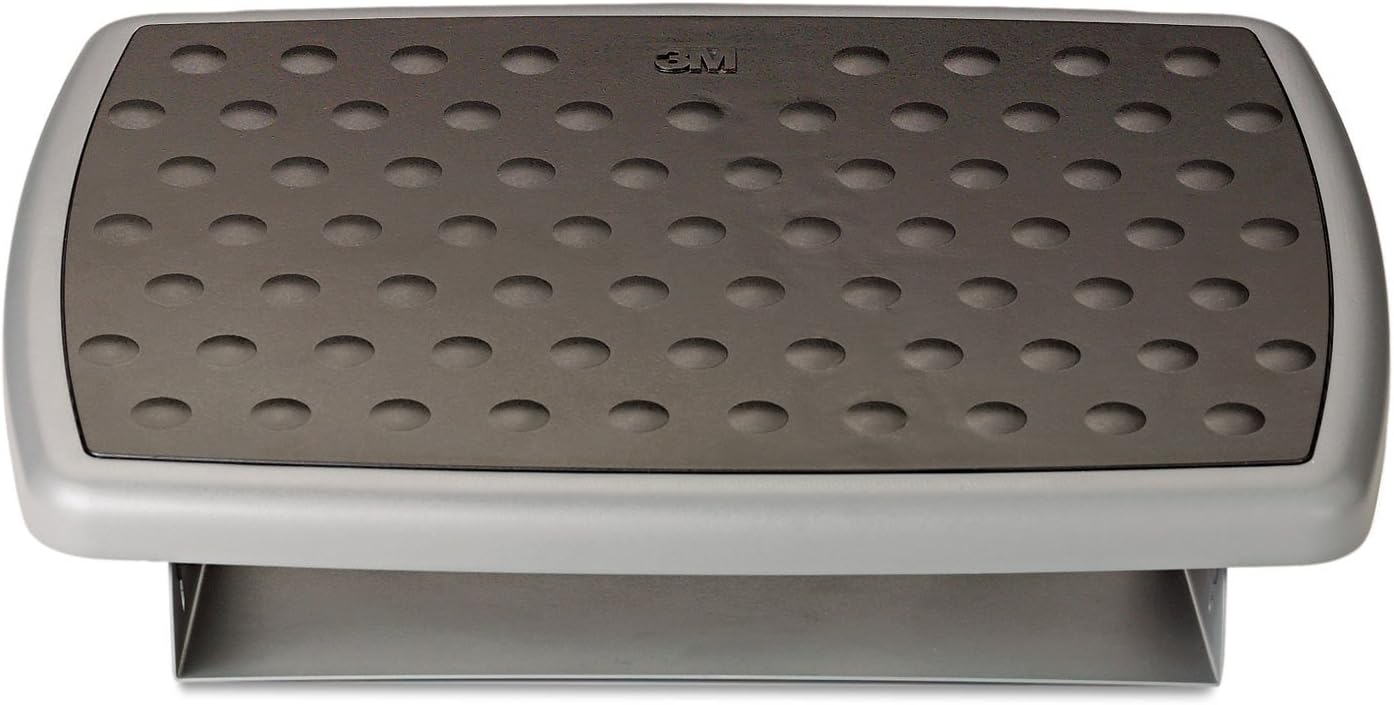
3M Adjustable Footrest
The 3M Adjustable Footrest's strongest clinical argument is institutional: it's the footrest most commonly approved through corporate procurement channels, most frequently found in office supply catalogs, and most likely to arrive in a standard ergonomics package without requiring individual purchase justification. None of that is a clinical advantage — but it's a practical reality that determines how many people actually use ergonomic tools versus research them and never acquire them.
On the clinical merits, the 3M scores identically to the HUANUO across most Layer I dimensions. The differentiation arrives in construction quality (II.1: 6 vs HUANUO's 5) and a more established brand warranty posture. The 3M's hard plastic platform with textured surface provides adequate but not exceptional pressure distribution — it's a functional tool, not a comfortable one. Users who spend long hours with feet resting passively may notice the harder surface relative to foam alternatives. Users who move their feet frequently — those who adjust position throughout the workday — will find the hard surface less of an issue.
- Widely available through corporate procurement
- Better construction than HUANUO at same score
- Good price-to-value positioning
- Hard plastic surface — less comfortable for static rest
- No ergonomic certification
- No clinical differentiation from similarly priced alternatives
UPLIFT Desk Footrest
The UPLIFT Footrest's most distinctive DEAS feature is its II.1 Material & Construction score of 8 — the second-highest in this guide, trailing only the Humanscale products. UPLIFT's manufacturing standards, refined through its standing desk product line, carry over to this accessory: the construction quality is a clear step above most footrests at comparable price points. If long-term durability is the primary concern, the UPLIFT warrants serious consideration despite its Layer I scores sitting in the middle of the field.
The clinical performance profile is adequate but not exceptional. Neutral posture support and adjustability both score 7 — the product achieves what it promises for the average user without the clinical depth of the Humanscale rocker or the verified user satisfaction of the ErgoFoam. The Ergonomic Value Ratio of 5 reflects that while the UPLIFT is well-made, it is priced above where its clinical performance alone would justify.
The natural pairing here is the UPLIFT standing desk ecosystem. Users who are already UPLIFT desk owners receive an accessory that matches their workstation's build standards and may simplify returns or support interactions. Outside that ecosystem, the UPLIFT Footrest competes on quality against products with stronger clinical scores.
- Excellent construction quality (II.1: 8)
- Strong warranty coverage (II.3: 8)
- Natural fit for UPLIFT desk ecosystem users
- Priced above benchmark; value ratio doesn't keep pace with quality
- Clinical performance scores mid-field despite build quality premium
Everlasting Comfort Memory Foam Foot Rest
The Everlasting Comfort stands out in this guide for a single reason that earns it a high-value designation despite mid-field clinical scores: a lifetime warranty on a sub-benchmark product is a genuine differentiator. Most footrests in this price range offer 1-year or no documented coverage. Everlasting Comfort's warranty posture signals product confidence and provides a meaningful consumer protection that changes the long-term cost calculation, even if it doesn't change the clinical performance outcome.
The II.4 score of 9 — the same as the ErgoFoam — reflects consistently high Amazon ratings across a large review base. Verified user reliability at this level is a meaningful data point: it means the product performs as expected for the majority of purchasers, and that durability complaints are not a significant pattern. For a passive foam footrest with no moving parts, this is the primary reliability risk, and it's largely absent here.
Clinical scores are constrained by fixed geometry. Without height or angle adjustment, the Everlasting Comfort cannot serve users whose foot position needs to deviate from its factory-set incline. It's the right tool for the average-stature user who simply needs their feet off the floor at a standard angle — and a poor match for anyone who falls outside that window.
- Lifetime warranty — best in guide for passive foam tier
- High verified user reliability (II.4: 8)
- Below-benchmark price with solid value ratio
- No adjustability — fixed height and angle (I.2: 3)
- Excludes users outside average stature window
Eureka Ergonomic Tilt Adjustable Footrest
The Eureka's core clinical argument is tilt adjustment done at a budget price point. Among products scoring 6.2 or below, the Eureka provides the most direct angular control of the footrest surface — which matters specifically for users who need to vary their ankle position throughout the day to manage plantar fasciitis, Achilles tightness, or general lower-leg fatigue from static loading.
The clinical performance scores match the HUANUO and 3M in most dimensions, and the product competes directly in the same market tier. The differentiating factor is the tilt mechanism's quality of execution — the Eureka's adjustment is tool-free and provides discrete locking positions, which is more clinically useful than a free-floating tilt that doesn't hold position under load. The verified user reliability at 5 suggests adequate but not exceptional long-term satisfaction, consistent with a mid-tier product without significant durability complaints.
- Tilt adjustment holds position under load
- At-benchmark pricing
- Adequate for average user across all primary dimensions
- No differentiated advantage vs HUANUO or 3M at this score tier
- No ergonomic certification
Cushion Lab Ergonomic Footrest
Cushion Lab's product line consistently emphasizes comfort over clinical adjustability, and the footrest follows this pattern. The Neutral Posture Support score of 7 is above average for this tier — the foam geometry and density are well-considered for users at mid-stature — but the Adjustability Range of 3 signals that the product is essentially a fixed-geometry tool. The cushioning quality is real; the clinical range is limited.
For users seeking passive comfort improvement rather than active ergonomic optimization — those who already have a functional workstation setup and want better foot cushioning specifically — the Cushion Lab is a reasonable choice at this score. For users who are uncertain whether their workstation geometry is correct and need adjustability to find the right position, the HUANUO or ErgoFoam are better starting points.
- Above-average foam quality for the tier (II.1: 7)
- Good user satisfaction signal (II.4: 7)
- Good posture support for average-stature users
- Very limited adjustability (I.2: 3) — essentially fixed geometry
- Not appropriate for users needing positional flexibility
ComfiLife Memory Foam Foot Rest
The ComfiLife closes out the top 10 with a profile nearly identical to the Everlasting Comfort but with one meaningful difference: a lower verified user reliability score (5 vs 8). Both products are fixed-geometry memory foam platforms at below-benchmark pricing. Both share the same clinical limitations — no adjustability, suitable only for average-stature users at the factory angle. The ComfiLife's user reliability data suggests a slightly higher rate of long-term dissatisfaction, likely from durability concerns in the foam density over extended daily use.
It clears the clinical minimum threshold and represents an accessible entry point for users new to footrests. For any user with budget flexibility, the ErgoFoam provides meaningfully better clinical value at a comparable price. The ComfiLife is not a poor product — it's the appropriate floor of the recommended category range.
- Below-benchmark price (III.1: 9)
- Meets minimum clinical threshold
- Good value ratio given price tier
- No adjustability (I.2: 3)
- Lower verified reliability than same-tier competitors
- ErgoFoam outperforms at comparable price
Footrest Buying Guide: What Actually Matters
Adjustability Type Determines Clinical Utility
Height adjustability and angle adjustability are not interchangeable. Height adjustment changes how much lift you get — resolving the gap between your feet and the floor. Angle adjustment changes the tilt of the platform — affecting ankle position and lower-leg muscle engagement. The best footrests in this guide offer both. If you can only have one, height adjustability addresses the more common clinical problem (feet not reaching the floor), but angle adjustment becomes critical if you have existing plantar fascia, Achilles, or lower-leg tension that requires dynamic positioning throughout the day.
Foam Density: The Feature No Label Mentions
Memory foam footrests vary dramatically in density, and manufacturers almost never publish this specification. The clinical consequence is that a footrest that feels comfortable in the first week may compress to an ineffective platform by month three. The best proxy for foam density at purchase is verified user review patterns — products with large review bases and ratings consistently above 4.3 on Amazon are statistically less likely to have foam compression complaints. Use II.4 scores in this guide as your indicator; ErgoFoam and Everlasting Comfort earned the highest reliability scores in this category.
Dynamic vs Static: A Real Clinical Choice, Not a Marketing Angle
The Humanscale rocker series represents a genuine biomechanical design philosophy, not a product trend. Continuous micro-movement at the foot and ankle promotes muscle pump activity, which is clinically measurable in venous return and lower-extremity fatigue reduction. The relevant question is whether you need this feature: if you already alternate sitting and standing, take regular walking breaks, or have no history of lower-extremity fatigue, the rocking mechanism adds cost without proportional clinical benefit. If you sit continuously for 6+ hours and have limited opportunity for movement breaks, the FR300's rocking mechanism addresses a real physiological need.
What's Overstated
Surface texture patterns (grooves, ridges, massaging nubs) are marketed as active features but have no documented clinical benefit for seated workstation use. Anti-slip bases are universal in the category and not a differentiator. Brand-name foam marketing ("advanced memory foam," "premium orthopedic foam") is uncertified and not clinically meaningful without documented density specifications.
Pain-Specific Guidance
How to Set Up Your Footrest Correctly
- 1.Set chair height first. Adjust your chair so your elbows are at approximately 90° with your forearms parallel to the desk surface. Do not start with your feet — chair height is determined by upper-body geometry.
- 2.Assess foot position. With your chair at the correct height, note whether your feet rest flat on the floor with thighs roughly parallel. If there is a gap between your feet and the floor, or if your thighs are angled down significantly, a footrest is indicated.
- 3.Place the footrest flat, directly under your feet. Footrests should not require reaching or angling your legs to contact the surface. If you're stretching to reach it, it's too far forward.
- 4.Adjust height so thighs are roughly parallel to the floor. Knee flexion should be at approximately 90° with hips and knees at similar heights. Thighs pressing into the front of the seat signal too low a position.
- 5.Set angle for comfort. A slight upward tilt (10–15°) is standard for most users. Users with Achilles tightness may prefer a flatter or even slight negative tilt position.
- 6.Verify monitor and keyboard positions haven't changed. Adding a footrest changes your effective seated height slightly. Recheck that your eye level aligns with the top third of your monitor and that your wrists remain neutral at the keyboard.
- 7.Allow a 2–3 day adjustment period. A correctly set footrest may feel unfamiliar if you've worked without one for years. Discomfort that resolves within 3 days is positional adaptation. Discomfort that increases suggests the footrest height or angle needs further adjustment.
Frequently Asked Questions
Whether you need a footrest is determined by one measurement: do your feet rest flat on the floor when your chair is at the height that positions your elbows correctly for your keyboard? If they don't, you need some form of foot support. This is a clinical determination, not a preference. Anthropometric data from ANSI/HFES 100-2007 suggests that approximately a third of seated workers — particularly those below 5'7" — cannot achieve both correct upper-body geometry and full foot-floor contact simultaneously. For these users, a footrest is a functional ergonomic necessity, not an optional accessory. For taller users whose feet rest flat at correct chair height, a footrest adds no clinical benefit and may actually create a suboptimal ankle angle.
It depends on your work pattern. The Humanscale FR300's rocking mechanism produces measurable calf muscle engagement and supports venous return in a way that no static footrest can replicate. This is a real clinical benefit — but only for users who sit continuously for extended periods without movement breaks, standing desk use, or regular walking opportunities. If you alternate sitting and standing, take walking breaks every hour, or work in an active environment, the rocking mechanism adds cost without meaningful additional benefit. The premium over the ErgoFoam is substantial; it should be justified by the specific clinical need.
The footrest category has no dominant ergonomic certification standard equivalent to BIFMA for chairs or Greenguard for office furniture. No footrest in this guide holds an independently verified ergonomic certification because none exists at the product category level. What does exist are basic safety certifications (CE, RoHS) that apply to material safety rather than ergonomic function. This is a known gap in the category, and it means consumers must rely on clinical scoring frameworks like DEAS and verified user data rather than certification labels. The II.2 gap is structural to the footrest category — it's not a reflection of individual product shortcomings.
Yes, but only in the seated position. When the desk is in standing configuration, foot positioning is managed through standing posture, anti-fatigue mat selection, and footwear — not a footrest. Using a footrest while standing would create an unstable surface and introduce tripping risk. If you have a sit-stand desk and use a footrest while seated, store the footrest to the side when transitioning to standing mode. The UPLIFT Desk Footrest is designed with this workflow in mind and may integrate more cleanly with a UPLIFT standing desk setup.
Ten additional products were scored using DEAS methodology but scored below 6.0 or were superseded by higher-performing products in the same clinical niche. The BlissTrends Dual Layer Foot Rest (6.0) and Kensington Comfort Memory Foam Footrest (5.8) both clear the minimum clinical threshold but offer no differentiation from the top 10 at comparable prices. The Safco Task Master Adjustable Footrest (5.8) provides adjustability but its low construction score (III.1: 2) undermines durability confidence. The POGO Ergonomic Footrest (5.8), Fellowes Standard Adjustable Footrest (5.5), Mind Reader Active Adjustable Footrest (5.4), RIAMTGCX Adjustable Footrest (5.4), and ScaleBeard Multi Mode Footrest (5.1) all score below the minimum threshold for the active top 10. The Leemart Adjustable Footrest (5.1) and Amazon Basics Under Desk Footrest (4.6) fall furthest below category standard — the Amazon Basics in particular scores a 4 on Neutral Posture Support, which signals inadequate clinical performance even as a baseline tool. None of the excluded products are recommended.
For foam-based footrests, replacement is typically warranted when the foam has compressed to the point where it no longer provides measurable height lift — usually 2–4 years with daily use for mid-density foam products, and potentially longer for higher-density products like the ErgoFoam. For platform-and-mechanism footrests like the Humanscale FR300, replacement is driven by mechanism wear rather than foam compression, and the commercial-grade construction typically extends useful lifespan beyond 5 years. A practical indicator: if you notice your chair height needs adjustment to maintain the same posture — or if your feet feel like they're resting on the floor rather than a surface — the foam has likely compressed below clinical utility.
Affiliate disclosure: DeskDoctor earns a commission when you purchase through links on this page. Affiliate relationships do not influence product selection or DEAS scores. All scores are calculated before affiliate arrangements are finalized. See our methodology page for full scoring transparency.
Clinical disclaimer: Content on DeskDoctor is for informational purposes and reflects the professional opinion of a certified HEAS based on available product data and clinical experience. It does not constitute medical advice. If you are experiencing pain, consult a qualified healthcare provider before making ergonomic changes.
--- BLOG METADATA --- Blog Title: Best Ergonomic Footrests 2026: HEAS-Reviewed & DEAS-Scored Blog Excerpt: A certified HEAS ranks the top 10 ergonomic footrests using the DEAS methodology. Clinical scores, honest picks, and no marketing fluff. SEO Meta Title: Best Ergonomic Footrests 2026 | HEAS-Reviewed SEO Meta Description: HEAS-certified ergonomist ranks the 10 best ergonomic footrests of 2026 by DEAS score. Clinical performance, real adjustability data, and honest picks. Tags: footrests hip-leg-pain back-pain general-pain setup prevention read-30min
0 comments