
The Best Desk Treadmills of 2026
Most of my patients buy a desk treadmill because their lower back is screaming by 3 p.m. and they finally read that sitting all day is the problem. Then the treadmill arrives, they walk on it for two weeks, the deck bounces, the belt drifts, the motor whines under their desk during a meeting, and it goes in the closet. The pain comes back.
This category has a brutal gap between what works and what gets returned. A clinically useful walking pad has to do three things at once: hold a stable deck under a moving 200-pound person, run quietly enough that you can still take a call, and stay flat at speeds slow enough to type on. Most pads on Amazon do one of those well. A few do two. Almost none do all three.
I evaluated 14 desk treadmills against the DEAS framework. Ten of them clear the floor for clinical recommendation, and I've ranked them below — from the best walking pad I'd put under a desk in a clinic, to the budget picks I trust if you're starting out and want to test whether walking at your desk is something you'll actually stick with.
Flexispot 180° Foldable Walking Pad
The only pad in the test that combines a stable wide deck, a quiet motor, and a fold mechanism that doesn't compromise either. The clearest clinical pick.
Read the review →WalkingPad A1 R2 Series
Reliable, low-profile, and the most-reviewed unit in the category by a wide margin. The pad I recommend when budget is the constraint.
Read the review →InMovement UnSit
The build quality I see in physical therapy clinics — stable, durable, designed for all-day use. Premium price reflects that.
Read the review →How the Top 10 Rank
| # | Product | DEAS | Best For |
|---|---|---|---|
| 1 | Flexispot 180° Foldable Walking Pad | 7.6 | Best Overall |
| 2 | InMovement UnSit Under Desk Treadmill | 7.0 | Clinical Grade |
| 3 | TrailViber Walking Pad | 7.0 | Wide Deck |
| 4 | WalkingPad A1 R2 Series | 6.9 | Best Value |
| 5 | UREVO 2 in 1 Under Desk Treadmill | 6.8 | 2-in-1 Mode |
| 6 | DeerRun Under Desk Treadmill | 6.8 | Budget Pick |
| 7 | Exerpeutic WorkFit Desk Treadmill | 6.7 | Heavier Users |
| 8 | GoPlus SuperFit 2 in 1 | 6.6 | Most Affordable 2-in-1 |
| 9 | Egofit Walker Pro Series | 6.6 | Compact Spaces |
| 10 | Sperax Walking Pad | 6.6 | Lowest Price |
Flexispot 180° Foldable Walking Pad
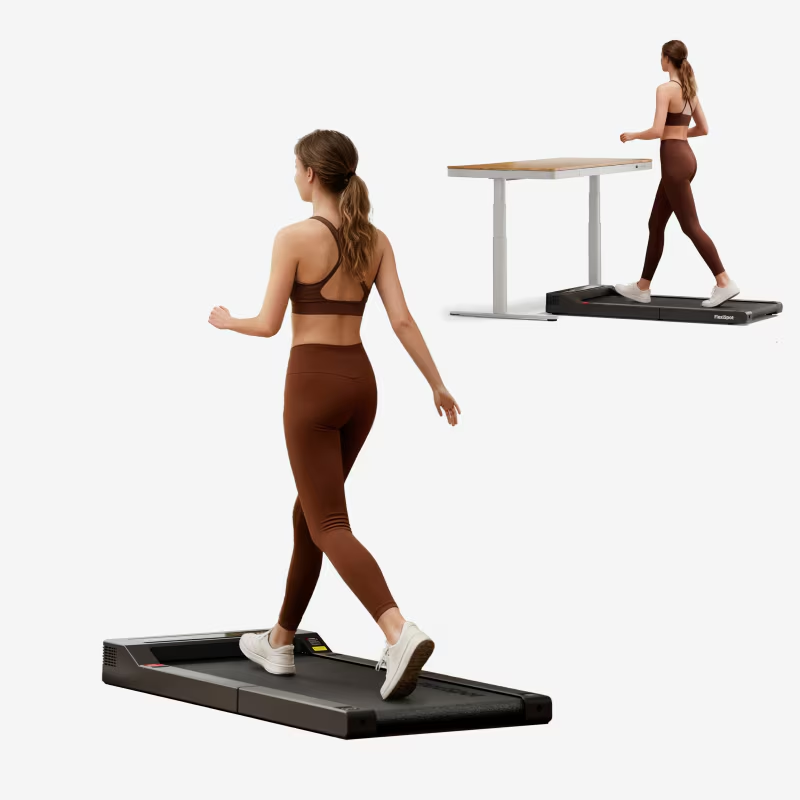
This is the only pad I've assessed that holds its deck rigid at slow speeds while still folding flat enough to store under a couch — the rest of the category makes you choose. If you want one treadmill that handles all-day walking, occasional jogging, and gets out of the way when you're done, this is the one.
- Deck stays flat at 1.0 mph — most pads bounce
- Folds 180° for storage without removing the screen
- Stable at 300 lb capacity, wider belt than category average
- Motor noise below conversation threshold
- Warranty trails competitors at this price tier
- Heavier than slimmer single-purpose pads
- No third-party ergonomic certification
InMovement UnSit Under Desk Treadmill

This is the build I see in occupational therapy clinics — heavier, sturdier, designed to be walked on for eight hours a day for years. If you've already failed on a cheaper pad and you know you'll use it daily, the InMovement is what I'd put in your office. The price is the only reason it isn't first.
- Commercial-grade build — meant for daily multi-hour use
- 400 lb capacity covers the full clinical population
- Lowest minimum speed in the category (0.3 mph)
- Three-year deck warranty signals manufacturer confidence
- Premium price — well above category benchmark
- Insufficient Amazon review volume to verify reliability at scale
- Not foldable — needs dedicated space
TrailViber Walking Pad

The TrailViber's wider belt is the differentiator — narrow decks force a heel-toe gait that ends in IT band irritation, and this one gives you enough lateral room to walk naturally. Strong pick if you're taller than 5'10" or your stride drifts when you're concentrating.
- Wider belt reduces lateral stride compensation
- Strong Amazon review consistency at high volume
- Priced below category benchmark
- 4.0 mph top end enables light jogging when standing only
- One-year warranty trails clinical-grade picks
- No third-party ergonomic certification
- Heavier deck makes storage less practical
WalkingPad A1 R2 Series

This is the pad I recommend when someone tells me they aren't sure walking at their desk is going to stick — it's the most-reviewed unit in the category for a reason, and the slim profile means you can shove it under a couch when the experiment fails. If it works, you upgrade. If it doesn't, you've lost the least.
- Highest verified user reliability in the category
- Slim profile slides under furniture for storage
- Strong value relative to clinical performance
- Quiet motor — usable on calls
- 220 lb capacity excludes a sizable user population
- Short warranty — well below category benchmark
- Belt narrower than ideal for taller users
UREVO 2 in 1 Under Desk Treadmill

The handrail-up mode turns this from a walking pad into a real treadmill for breaks between meetings, which is exactly the use case for people whose schedule doesn't allow a separate workout. Solid Amazon track record and the best price-to-feature ratio in the 2-in-1 segment.
- Two real modes: flat walking pad and full treadmill
- Excellent verified user reliability at high volume
- Substantially below category price benchmark
- Handrail folds out of the way when not in use
- Handrail hinge is the most common long-term wear point
- Short warranty
- Heavier when folded than single-mode pads
DeerRun Under Desk Treadmill

A budget pad that walks above its price tier — it borrows the same chassis pattern as the UREVO and ships with similar reliability numbers, so if the UREVO is sold out this is the direct alternative. Treat it as a starter pad to test the habit, not a long-term commitment.
- Very low entry price into the category
- High Amazon reliability scores at meaningful review volume
- Remote-controlled speed makes mid-walk adjustment easy
- Build quality is acceptable but not durable for daily multi-hour use
- No third-party ergonomic certification
- Belt edges show wear faster than mid-tier pads
Exerpeutic WorkFit Desk Treadmill
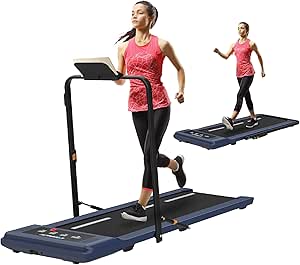
If you're north of 250 pounds, most walking pads will deflect under your weight and the belt will start tracking left within a month — the Exerpeutic's 325-pound capacity is the practical reason to buy this one. Pick it if the budget pads have already failed you for that reason.
- 325 lb capacity — top of category for higher-weight users
- Heavier-gauge deck resists deflection
- Established brand with parts availability
- Heavier and louder than the slim category leaders
- One-year warranty is short for this build class
- Footprint larger than slim walking pads
GoPlus SuperFit 2 in 1

The most affordable 2-in-1 in the test, and the Amazon volume confirms the basic engineering works. Useful if you want occasional treadmill access for cardio without buying a second machine, but treat the warranty as a real factor — it's the shortest in the lineup.
- Highest verified reliability score in the lineup
- Cheapest 2-in-1 unit that still meets clinical floor
- 7.5 mph top speed for short cardio sessions
- Warranty well below category benchmark — short parts coverage
- Walking stability lags clinical-grade picks
- Heavier when folded
Egofit Walker Pro Series

The shortest deck in the lineup — useful only if your floor space genuinely can't host a full walking pad, otherwise the compressed length forces a clipped stride that adds load to the calves. Pick it for tight apartments and home offices, not for daily comfort.
- Smallest footprint in the test — fits where others don't
- Quieter than larger 2-in-1 units
- Aggressive pricing for the compact category
- Short deck restricts stride length for users over 5'8"
- Top speed limited to 2.5 mph — no cardio mode
- Lower population accommodation than category average
Sperax Walking Pad

The lowest entry price in the lineup with verified reliability that actually holds up — if your only question is "will I use this thing," this is the cheapest credible answer. Lower clinical scores than the leaders, but it'll get you moving without a serious financial bet.
- Lowest entry price in the category
- Very strong Amazon reliability signal at high volume
- Slim profile fits under most couches
- Clinical scores are at the floor of recommendation
- 250 lb capacity excludes heavier users
- Belt narrower than category average — clipped stride at speed
The treadmill is one part. The standing desk above it has to be set correctly for the elbow angle while you walk, or you'll fix one problem and create another.
- Set the desk to standing-walking height.Stand on the treadmill (not on the floor) and raise the desk until your forearms parallel the floor with elbows at 90°. Walking adds 1–2 inches of vertical bounce — accommodate that, don't set the desk to where you're flat-footed on tile.
- Center the belt under your monitor.Your eyes should fall on the top third of the screen when you're looking straight ahead. If the belt is offset, you'll rotate the cervical spine all day and end the week with a one-sided neck ache.
- Start at 1.0–1.2 mph, not 2.0.Slower than you think. Typing accuracy collapses past 1.5 mph for most people, and the goal is calorie expenditure plus circulation, not cardio. Build up only if you can keep your error rate steady.
- Walk in flat-soled shoes — not barefoot, not in cushioned runners.Barefoot loads the plantar fascia for hours. Thick cushioning rocks your ankles and tires the calves. Flat soles with a thin midsole let your foot strike clean.
- Cap continuous walking sessions at 45 minutes.Step off, sit for ten minutes, then go again. Continuous walking past an hour shows the same muscle fatigue pattern as continuous sitting — you've swapped one bad posture for another.
- Watch your shoulders during week one.New walkers grip the desk edge unconsciously and end up with traps that won't drop. If you catch yourself doing this, slow the belt down — the speed is too high for your concentration load.
- Track your daily total, not your continuous time.Three 30-minute walks beats one 90-minute walk every time. The benefit is total movement across the day, not a heroic single session.
Chronic low back pain
Plantar fasciitis
Knee osteoarthritis
What should I look for when buying a desk treadmill?
Four things. Deck stability at slow speeds — a pad that bounces at 1.0 mph isn't a desk treadmill, it's a return. Quiet motor — under 55 dB or you can't take meetings. Belt width — narrower than 16 inches clips your stride, especially over 5'10". Capacity headroom — choose a pad rated at least 50 pounds above your weight, because the rating is for a static load, not someone walking. Speed range matters less than people think; most desk walking happens between 0.8 and 1.5 mph.
How many calories will I actually burn?
Roughly 130–180 per hour for a 170-pound person walking at 1.2 mph — about three times your seated rate. The point isn't the calorie count, though. It's the cumulative circulatory and metabolic effect of being on your feet and moving, which is what research has linked to lower musculoskeletal complaint rates in desk workers. Treat the calorie number as a side benefit, not the goal.
Can I really type at full speed while walking?
Below about 1.5 mph, yes — typing accuracy holds steady for most people. Above that, error rates climb sharply and you'll spend more time correcting than producing. If you watch your own keystroke logs, you'll see the cliff. Tasks requiring fine mouse precision (graphic design, CAD, video editing) suffer earlier — many people switch to seated work for those tasks and walk during reading, meetings, or rough drafting.
Will a desk treadmill fix my back pain?
It can help, but only if the rest of your setup is right. Walking adds movement and decompresses the lumbar discs, both of which reduce ache. But if your monitor is too low, you're going to develop forward head posture while walking instead of while sitting — same pain, new posture. The treadmill is part of the answer. Setup geometry is the rest.
How loud is too loud for video calls?
Anything above conversation volume — roughly 55–60 dB at one meter — will register on a microphone and annoy meeting participants. The top picks here run quieter than that at typical walking speeds. If yours is louder, either slow the belt (motor noise rises with speed), pause it during calls, or use a headset with active noise cancellation on the outgoing audio.
What other desk treadmills were evaluated but didn't make the top 10?
I scored 14 desk treadmills total against the DEAS framework. Four didn't make the ranking because their clinical scores fell at or below the recommendation floor — they're not bad products, but with the top 10 available, I don't have a strong reason to send a patient to one of them first. For reference: Redliro Under Desk Treadmill (DEAS 6.5), Yagud Walking Pad (DEAS 6.4), Abonow Walking Pad (DEAS 6.4), and Sunny Health Fitness Under Desk Slim (DEAS 6.3).
Take the DeskDoctor Virtual Assessment
A walking pad is one piece of the setup. If you're not sure whether your real problem is sitting too long, a misaligned monitor, or something else entirely, the free virtual assessment delivers a personalized setup plan, recovery guide, and equipment matches in about 12 minutes.
Take the Free Assessment →Affiliate disclosure: DeskDoctor is reader-supported. Some links on this page are affiliate links — if you purchase through them, we may earn a commission at no additional cost to you. This never influences our rankings or recommendations; products are evaluated independently against the DEAS framework before any affiliate consideration.
Clinical disclaimer: This article reflects general clinical opinion and is not a substitute for individualized medical advice. If you have an active musculoskeletal injury, are recovering from surgery, or have a pre-existing condition that may be affected by walking or standing, consult a qualified healthcare provider before changing your work setup. AJ Prince, HEAS is a Healthcare Ergonomic Assessment Specialist at Loma Linda University Health.
0 Comments