
The Top 10 Standing Desk Converters of 2026
If you can't replace your desk but your lower back is screaming by mid-afternoon, a converter is the fix most of my patients reach for first. It sits on top of your existing desk and lifts your keyboard and monitor to standing height, so you can break up the long sitting blocks that flatten your lumbar curve and load your discs. The problem is that most converters on the market do the lifting part badly — they wobble at standing height, they top out too low for anyone tall, or they force your wrists into extension because the keyboard deck and monitor shelf move together as one fixed unit.
What you're actually looking for is a converter that reaches a true standing height for your body, holds steady when you type, and keeps your keyboard slightly below your elbows while your screen sits at eye level. That combination is rarer than the product photos suggest. A converter that gets the height right but shakes every time you press a key isn't solving your problem — it's just relocating your discomfort to your shoulders.
I evaluated 20 standing desk converters against the DeskDoctor Equipment Assessment Standard. I'll be honest up front: this is not a category full of clinical excellence. Only one product cleared the "DeskDoctor Recommended" threshold, and several popular sellers landed below the category standard once their stability and adjustability were scored properly. The 10 below are the ones worth your attention — ranked exactly as the numbers fell.
DEAS 7.3
The only converter in the field that lifts on a stable electric column instead of a spring-loaded Z-frame. It holds steady at full standing height and reaches a genuine range for tall users.
Read review ↓DEAS 6.5
The only top-five pick priced at or below the category benchmark. You give up a little construction polish, but the clinical fundamentals hold up.
Read review ↓DEAS 6.2
Commercial-grade construction and a counterbalance lift that floats to any height one-handed. The score is held back by premium pricing, not by the hardware.
Read review ↓| # | Converter | DEAS | Best For |
|---|---|---|---|
| 1 | Uplift Desk E7 | 7.3 | Stability at standing height |
| 2 | VariDesk Pro Plus 36 | 6.7 | Wide work surface |
| 3 | Ergotron WorkFit-TX | 6.5 | Wrist-neutral typing |
| 4 | FlexiSpot M7 | 6.5 | Budget-conscious buyers |
| 5 | Humanscale Eco | 6.2 | Build quality |
| 6 | Versa Tables PowerPro | 5.9 | Powered lift on a budget |
| 7 | Desky Zero | 5.3 | Low-profile setups |
| 8 | UPLIFT E3 Compact | 5.3 | Small desks & laptops |
| 9 | ApexDesk ZT Series | 5.1 | Entry-level electric |
| 10 | Rocelco 32" | 4.9 | Lowest entry price |
All 20 converters were scored against the DEAS framework. The 10 above are the highest-ranked; the remaining 10 are listed with their scores in the FAQ.
Uplift Desk E7 Electric Standing Desk Converter

This is the converter I point patients to when the wobble at standing height is what's actually driving their shoulder and forearm fatigue — the electric column holds dead steady where every spring-loaded model in this field shakes. If you're tall and most converters leave you hunching at "standing" height, this is the one that finally reaches you.
Strengths
- Electric column eliminates the standing-height wobble that defines this category
- Top-of-class construction built to commercial standards
- 10-year warranty — double the desk-category benchmark
Trade-offs
- Priced well above the converter benchmark — the weakest part of its score
- Carries fewer than 50 Amazon reviews, so long-term user reliability isn't yet measurable
- Heavy; not something you'll move between rooms
VariDesk Pro Plus 36

If you run dual monitors or spread out with papers, this is the converter with enough deck to do it without your keyboard creeping toward the edge. It's a proven, well-built workhorse — just know the two tiers rise together, so you can't fine-tune keyboard height independently of your screen.
Strengths
- Wide two-tier surface keeps the keyboard centered under your hands
- Solid construction with third-party certification behind its claims
- 5-year warranty matches the desk-category benchmark
Trade-offs
- Keyboard and monitor tiers rise as one — no independent height tuning
- Priced above the converter benchmark
- Spring-assisted lift carries more flex at full height than an electric column
Ergotron WorkFit-TX Standing Desk Converter

This is the converter I recommend when wrist pain is the patient's main complaint — the keyboard tray sits below the work surface, which is the geometry that actually keeps your wrists neutral instead of extended. If your forearms ache more than your back, this design solves the right problem.
Strengths
- Below-surface keyboard tray is the right geometry for wrist-neutral typing
- Constant-force lift moves smoothly and stays put at any height
- Strong Layer I clinical scores across the board
Trade-offs
- No relevant third-party ergonomic certification behind the design claims
- Priced well above the converter benchmark
- Larger footprint than most — needs a deep desk
FlexiSpot M7 Standing Desk Converter

This is the converter I steer cost-conscious patients to, because it's the only top-five pick that doesn't carry a premium price — and the clinical fundamentals still hold. You give up some construction polish versus the names above it, but not the things that actually protect your spine.
Strengths
- Priced at or below the converter benchmark — the strongest value in the top five
- Solid, even Layer I clinical scores with no glaring weak point
- Removable keyboard tray adds modest wrist-height flexibility
Trade-offs
- Height range and standing-height stability trail the leaders
- Warranty only meets, rather than exceeds, the category benchmark
- Spring lift takes a firm pull at the extremes of its range
Humanscale Eco Sit Stand Desk Converter

If you want the most refined hardware in the category and the price isn't the deciding factor, this is it — the counterbalance lift floats to any height with one hand and the build is genuinely commercial-grade. Just go in clear-eyed: you're paying a premium, and that's exactly where the score takes its hit.
Strengths
- Best-in-category construction — clinical-grade hardware throughout
- Counterbalance lift glides one-handed to any height with no shake
- Clamp mount keeps your desktop almost entirely free
Trade-offs
- Sits well above the converter benchmark on price
- II.4 reflects below-average Amazon marks — some users report fit issues
- Holds a laptop or single monitor well, but tight for a dual-screen setup
Versa Tables PowerPro Electric Standing Desk Converter
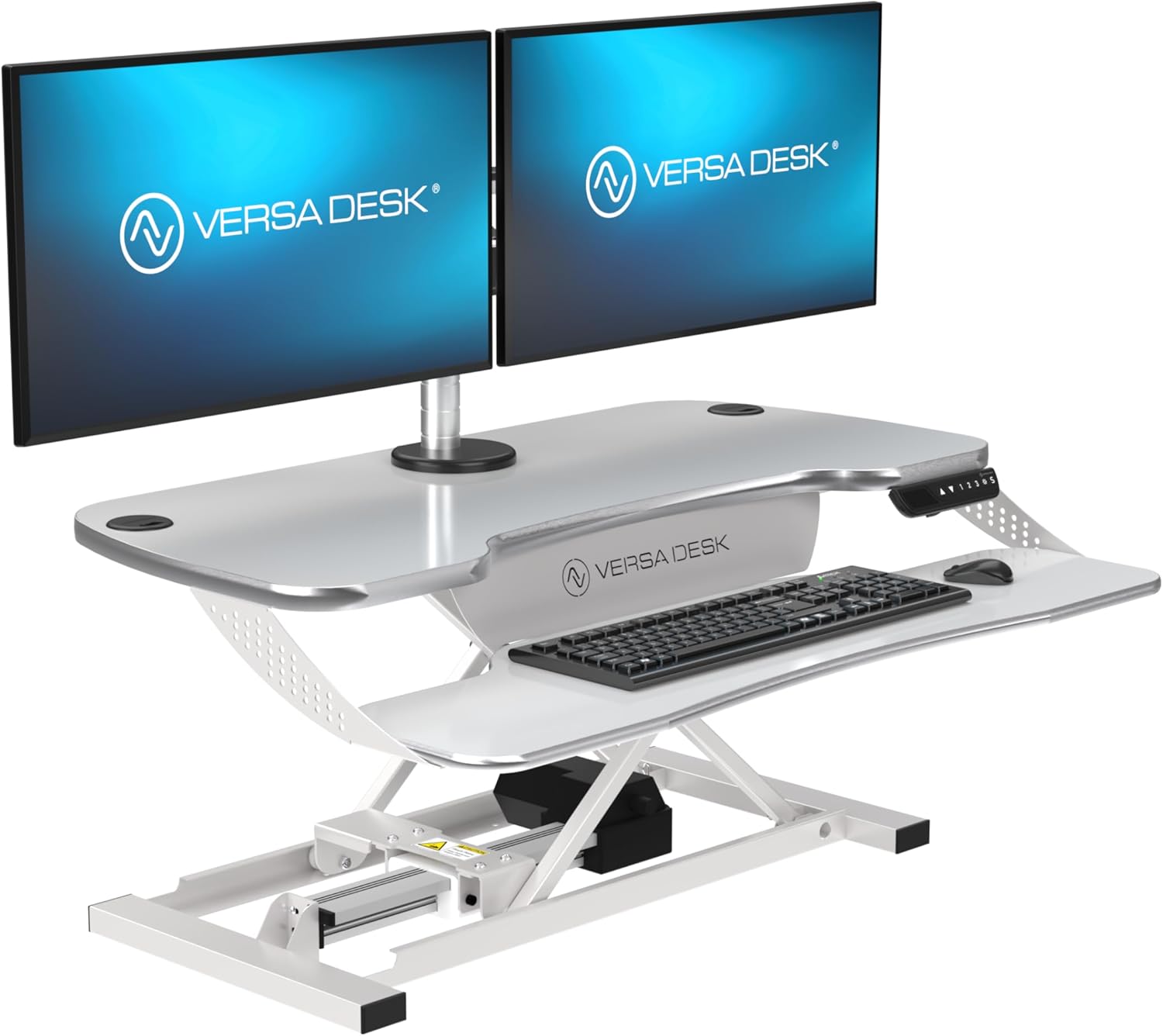
This is the converter for someone who wants a motor doing the lifting without paying electric-column money — it raises and lowers at the press of a button and is backed by an unusually long warranty. The clinical scores are middle-of-the-road, so treat it as a convenience pick rather than a posture upgrade.
Strengths
- Motorized lift at a lower price than column-style electric models
- 10-year warranty — double the desk-category benchmark
- Single-tier deck keeps the keyboard at a consistent plane
Trade-offs
- No relevant third-party certification behind its claims
- II.4 reflects below-average Amazon reliability marks
- Clinical scores cluster around the category midpoint — competent, not standout
Desky Zero Standing Desk Converter

If desk clutter is your real constraint, this converter folds nearly flat and stays out of the way when you're seated. The clinical performance is adequate rather than strong, so I'd reserve it for a secondary or occasional-use station rather than the desk where you spend eight hours a day.
Strengths
- Folds slim — barely there when you're seated
- Priced below the converter benchmark
- Adequate user-reliability signal from Amazon reviews
Trade-offs
- 1-year warranty sits well under the desk-category benchmark
- No third-party certification behind its claims
- Clinical scores are mid-pack — better as a secondary station
UPLIFT E3 Compact Standing Desk Converter

I'll be straight with you: this one ranks here mostly on price and warranty, not clinical performance — its posture and stability scores are the weakest in the top ten. It's a reasonable pick only if you work from a laptop on a cramped desk and just need to stand occasionally; it is not a fix for a serious back problem.
Strengths
- Priced at or below the converter benchmark
- 10-year warranty — double the desk-category benchmark
- Compact footprint fits a laptop on a genuinely small desk
Trade-offs
- Weakest Layer I clinical scores in the top ten — limited posture support and height range
- No room for a separate keyboard and monitor at correct relative heights
- Fewer than 50 Amazon reviews, so long-term reliability isn't yet measurable
ApexDesk ZT Series Electric Desk Converter

This is a budget way into a motorized converter, and the height range is acceptable for an average-height user. But the modest construction score and short warranty mean I'd only suggest it if a powered lift is non-negotiable and your budget genuinely won't stretch further.
Strengths
- Powered lift at an entry-level price point
- Height range works for an average-height user
- Two-tier surface separates keyboard and screen planes
Trade-offs
- Construction score sits below the category standard
- 1-year warranty trails the desk-category benchmark
- II.4 reflects below-average Amazon reliability marks
Rocelco 32" Height Adjustable Standing Desk Converter
This is the cheapest way to start standing at your desk, and on pure price it's hard to beat. But I want to be honest with you: it lands below the category clinical standard, so think of it as a low-risk way to test whether standing helps you — not as the converter you settle on long-term.
Strengths
- Lowest entry price in the field — well under the converter benchmark
- Two-tier surface separates keyboard and monitor planes
- Decent value ratio for someone simply testing whether standing helps
Trade-offs
- Composite lands below the DEAS category standard
- 1-year warranty and no third-party certification
- Limited adjustability — restricted height range for taller users
- Stand naturally and let your arms hang. Bend your elbows to 90 degrees — that height is where your keyboard belongs, not where the desktop sits.
- Raise the converter until the keyboard surface meets that elbow line. Your forearms should run parallel to the floor or tip very slightly downward.
- Set the monitor so the top of the screen is at or just below eye level. If the converter is one fixed unit, raise the screen with a stand or a stack of books.
- Pull the keyboard close enough that your upper arms stay near your torso. Reaching forward reintroduces the shoulder load you came here to escape.
- Check your wrists while typing — they should be flat, not bent up toward the screen. If they angle upward, the keyboard is still too high.
- Stand on a cushioned mat. A hard floor turns standing into its own fatigue problem within an hour.
- Alternate. Aim to switch between sitting and standing every 30 to 45 minutes — the change of position is what protects you, not standing all day.
Lower back ache from slouching
A dull, deep ache low in the back that builds through the afternoon as your pelvis tucks under and your lumbar curve flattens.
Fix: Break up sitting blocks. A converter that reaches true standing height lets you unload the discs every half hour.
Wrist and forearm strain
Burning or tightness in the wrists and forearms — often the price of a converter set too high, forcing the wrists into extension.
Fix: Set the keyboard to elbow height, not desktop height. A separate or below-surface keyboard tray helps most.
Neck and shoulder tightness
Stiffness across the shoulders and base of the neck from a screen that sits too low, pulling your head into forward flexion.
Fix: Raise the monitor to eye level independently of the keyboard. If the converter won't, add a separate monitor stand.
What should I look for when buying a standing desk converter?
Three things, in order. First, height range: the converter has to reach a true standing keyboard height for your body — this is where tall users get let down most often. Second, stability: it must hold steady at full standing height, because a converter that wobbles when you type just moves your discomfort to your shoulders and forearms. Third, independent keyboard and monitor adjustment — if the two surfaces only move together, you'll usually end up with either bent wrists or a low screen. Construction and warranty matter for longevity, but those three clinical fundamentals decide whether the converter actually protects you.
How many converters were reviewed for this guide?
20 standing desk converters were evaluated against the DEAS framework. The 10 above are the highest-scoring; the remaining 10, with their scores, are listed in the question below. It's worth being candid about what the numbers showed — this is not a category full of clinical excellence. Only one converter cleared the "DeskDoctor Recommended" threshold, and half the field landed below the category standard once stability and adjustability were scored properly.
Is a converter as good as a real standing desk?
Not quite, and it's fair to know why. A full standing desk lowers as a single stable surface, so your keyboard and monitor stay in correct relative position at every height. Most converters lift a smaller surface on a spring or scissor mechanism, which means more flex at standing height and, on single-tier models, no way to fine-tune keyboard and screen separately. A converter is the right call when you can't replace your desk — and a good one closes most of that gap — but if you're buying new, a proper standing desk is the cleaner solution.
How long should I actually stand each day?
The goal isn't standing all day — standing for eight hours straight creates its own problems, from foot fatigue to leg swelling. What protects you is changing position. In my assessments, the setups that work alternate sitting and standing roughly every 30 to 45 minutes. A converter makes that switch quick enough that you'll actually do it, which is the whole point.
Why do my wrists hurt after switching to a converter?
Almost always because the converter is set too high. People raise it to a comfortable desktop height and type with their wrists bent upward toward the screen — that's wrist extension, and it's a direct route to forearm strain. Set the keyboard surface to your elbow height instead, with forearms parallel to the floor. If your converter only has one fixed surface, a model with a separate or below-surface keyboard tray, like the Ergotron WorkFit-TX, solves this properly.
Which converters were reviewed but didn't make the top 10?
These 10 were evaluated and scored below the featured picks: Union & Scale FlexFit Manual Adjustable Desk Converter (DEAS 4.8), Mount-It! Electric Standing Desk Converter (DEAS 4.7), HUANUO 36" Standing Desk Converter (DEAS 4.8), VIVO Height Adjustable Standing Desk Converter (DEAS 4.8), Realspace P20 Standing Desk Converter (DEAS 4.8), SANODESK 35" Electric Standing Desk Converter (DEAS 4.5), Mount-It! Standing Desk Converter (DEAS 4.2), Cortesi Home Ursa Standing Desk Converter (DEAS 4.0), DriftDesk Portable Standing Desk Converter (DEAS 3.9), and The Twillery Co. Murray Standing Desk Converter (DEAS 3.9). Every one of these landed in "Below Category Standard" territory, generally on a mix of limited height range, standing-height instability, and short warranties.
Affiliate disclosure: DeskDoctor participates in the Amazon Associates Program and other affiliate programs. We may earn a commission on qualifying purchases made through links on this page, at no additional cost to you. Affiliate relationships never influence DEAS scores or rankings — products are evaluated against the same fixed framework regardless of commercial relationship.
Clinical disclaimer: This article is for general educational purposes and does not constitute medical advice, diagnosis, or treatment. AJ Prince is a Healthcare Ergonomic Assessment Specialist, not a physician. Persistent or severe pain should be evaluated by a qualified healthcare provider. Always consult a professional before making changes to your workstation if you have an existing injury or medical condition.
0 Comments