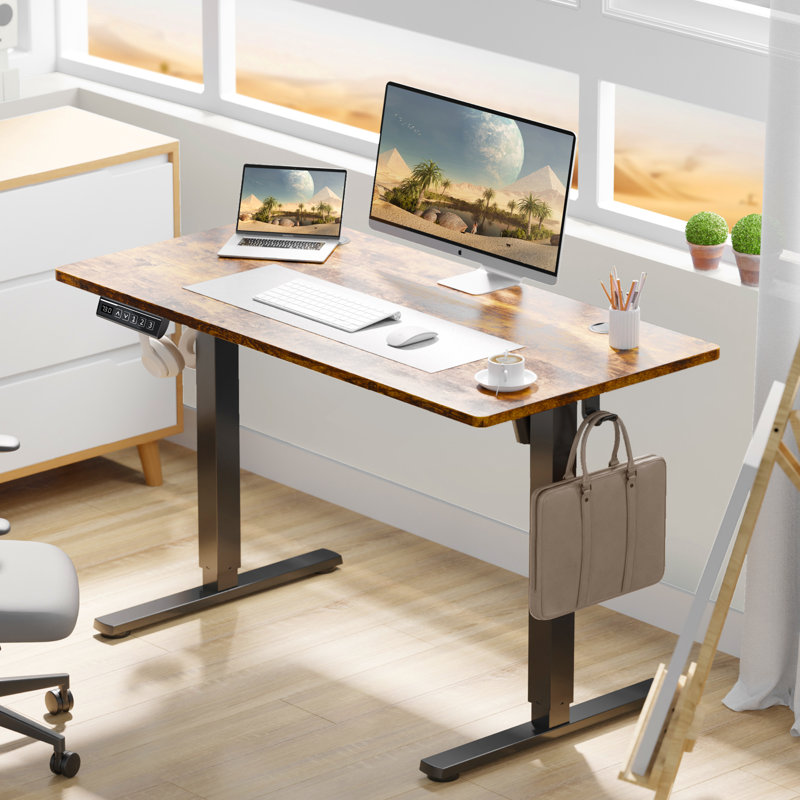
Short answer: the FlexiSpot E7 Plus is the best standing desk we’ve scored; the FlexiSpot E7 has the widest height range, covering most people from about 5′0″ to 6′4″, for less. Which one fits depends on your height: enter it below and the finder checks your sitting and standing heights.
The top score and the steadiest frame here: four legs, 440 pounds of lift and a reach of 51.6 inches. At about 5'6" and under, its 26-inch low point may be too high to sit at.
Not sure which one fits you? Use the fit finder above: it checks every one against your body in under a minute.
The ranking
Best to worst by DEAS score. After you use the finder, this list keeps only the desks that go low enough to sit at and high enough to stand at for your height.
Your height sets both ends of the range. Sitting, the desk belongs at or just below your elbows, which sit about 39% of your height off the floor; standing, about 62%. These are the ratios the Desk Doctor assessment uses, from Cornell’s CUErgo and OSHA’s computer workstation guidance, which puts the work surface at or just below elbow height, never above.
A desk only fits if its range covers both ends: low enough to sit at, high enough to stand at, and at least 25 inches deep so your screen isn’t in your face. A converter sits on the desk you have, so the finder checks that your desk can carry one for your screens, and that the desk isn’t already above your elbows when you sit. A converter only goes up from there.
The pick is the highest DEAS score that meets every one of those numbers. Fit comes before price: if nothing that fits is in your budget, the finder says so and shows the lowest-priced fit.
Start here: the heights your desk has to reach
Find your height. A desk has to go at least as low as the top of your sitting range, and as high as your standing height. These are the free assessment's numbers in normal shoes, the same ones the fit finder on our standing desk ranking uses.
Your height
Sitting: desk at
Standing: desk at
5'0″
20.5–24.5″
38″
5'2″
21–25″
39.5″
5'4″
22–26″
40.5″
5'6″
22.5–26.5″
42″
5'8″
23.5–27.5″
43″
5'10″
24.5–28.5″
44.5″
6'0″
25–29″
45.5″
6'2″
26–30″
47″
6'4″
26.5–30.5″
48″
The number to check first
If you're on the shorter side, the lowest height matters more than the highest. Check it against the chart before anything else.
Why a standing desk helps, and how
The desk is the foundation of every assessment I do. Get it wrong and no chair, monitor arm or keyboard tray will save you: your body spends the day working around whatever the desk forces on it.
The desks people buy fail in the same three ways. They don't go low enough for shorter people to sit at, they don't reach high enough for tall people to stand at, or they sway at standing height enough to make typing uncomfortable. What you want is a range that covers both of your heights, a frame that stays steady raised, and a warranty that covers the motor as well as the frame.
Of the 29 desks I scored, the FlexiSpot E7 is the one I'd put most people at, and its four-leg sibling, the E7 Plus, is the steadiest frame here. Start with the height chart below: it tells you in ten seconds whether a desk's range even covers you.
A sit-stand desk helps through the switching, not the standing. OSHA's guidance is to change your working position frequently through the day,1 and a desk that moves at the press of a button makes that easy enough to do.
What the research says
In a small four-week study, office workers given a sit-stand device sat about an hour a day less and reported 54% less upper back and neck pain, and most of the gains were gone within two weeks of the device being taken away.2 An international expert statement suggests building up to 2 hours a day of standing and light activity during working hours, then 4.3 Standing still all day isn't the goal either: prolonged standing at work is linked to low back and leg pain, fatigue and discomfort.4
66 minless sitting a day with a sit-stand device, in a small four-week study.2
54%less upper back and neck pain in the same study.2
What that means when you shop
Buy a desk that covers both of your heights, stays steady when raised, and has memory presets, then use them. The switching is what helps.
Full reviews
1 of 10. Best overall
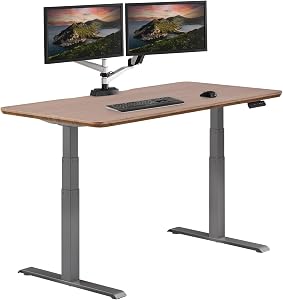
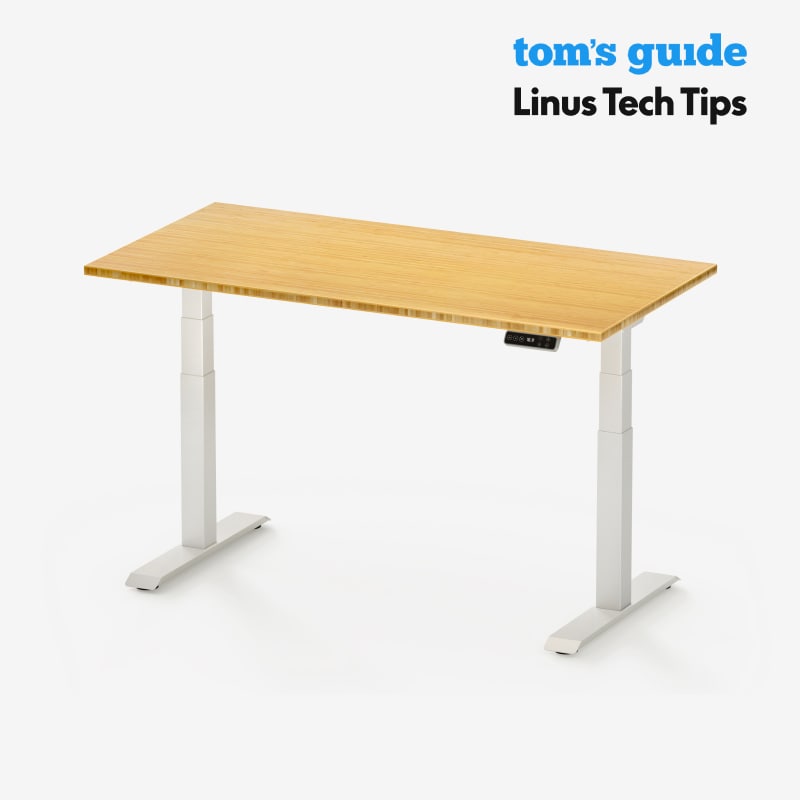
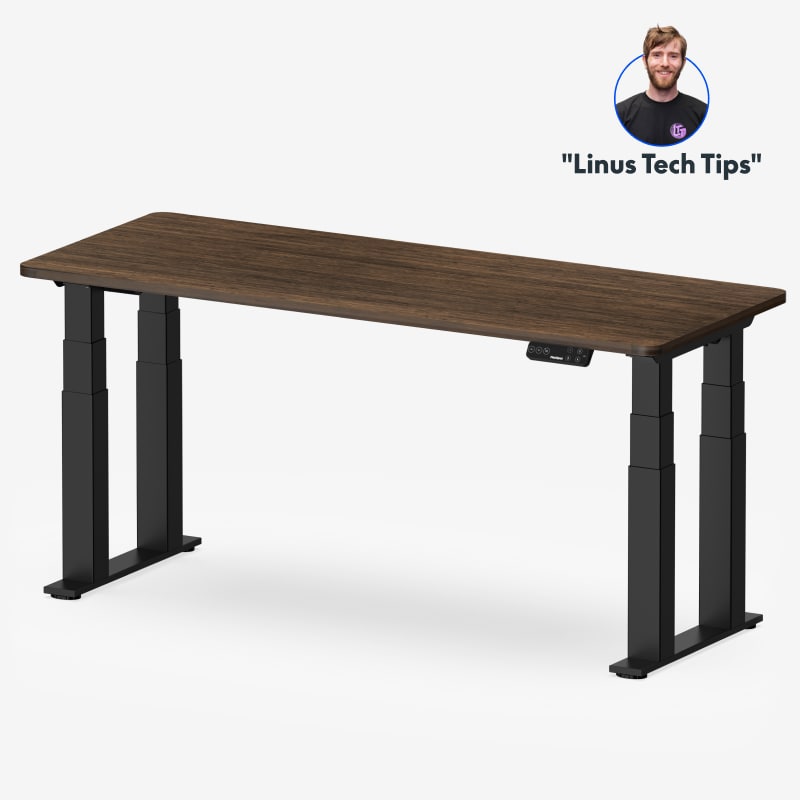
FlexiSpot E7 Plus
DEAS 8.4 out of 10
Four 3-stage legs; 26 to 51.6 inches; lifts 440 pounds. Frame, motor and mechanisms covered for 15 years.
The steadiest frame I've scored. Four legs keep it planted at standing height, where most desks start to sway, and it reaches 51.6 inches, enough for very tall people to stand at. Its lowest setting, 26 inches, is the catch: at about 5'6" and under, it may not come down far enough for you to sit at. That's when the E7 is the better buy.
Good: the top score and the top stability score here; reaches 51.6 inches; lifts 440 pounds; the top reliability score from user reviews; a 15-year warranty. Less good: its lowest height, 26 inches, is too high for many shorter people to sit at; no third-party certification listed.
Composite 8.4 on the DEAS (Desk Ergonomics Assessment Score). How we score
2 of 10. Widest height range
FlexiSpot E7
DEAS 8.3 out of 10
Two legs, dual motors; 22.8 to 48.4 inches without the top; 355-pound static load. 15-year warranty.
The desk I put most people at. Its range covers sitting and standing for nearly everyone from about 5'0" to 6'4", it's steady for a two-leg frame, and it scores a tenth behind the E7 Plus for less money. If you're very tall or load it heavily, step up to the four-leg Plus.
Good: the widest fit here; near-top stability; a strong price score; a strong reliability score from user reviews; a 15-year warranty. Less good: a two-leg frame sways a little more at full height than the four-leg E7 Plus; no third-party certification listed.
Composite 8.3 on the DEAS (Desk Ergonomics Assessment Score). How we score
3 of 10. Best build quality
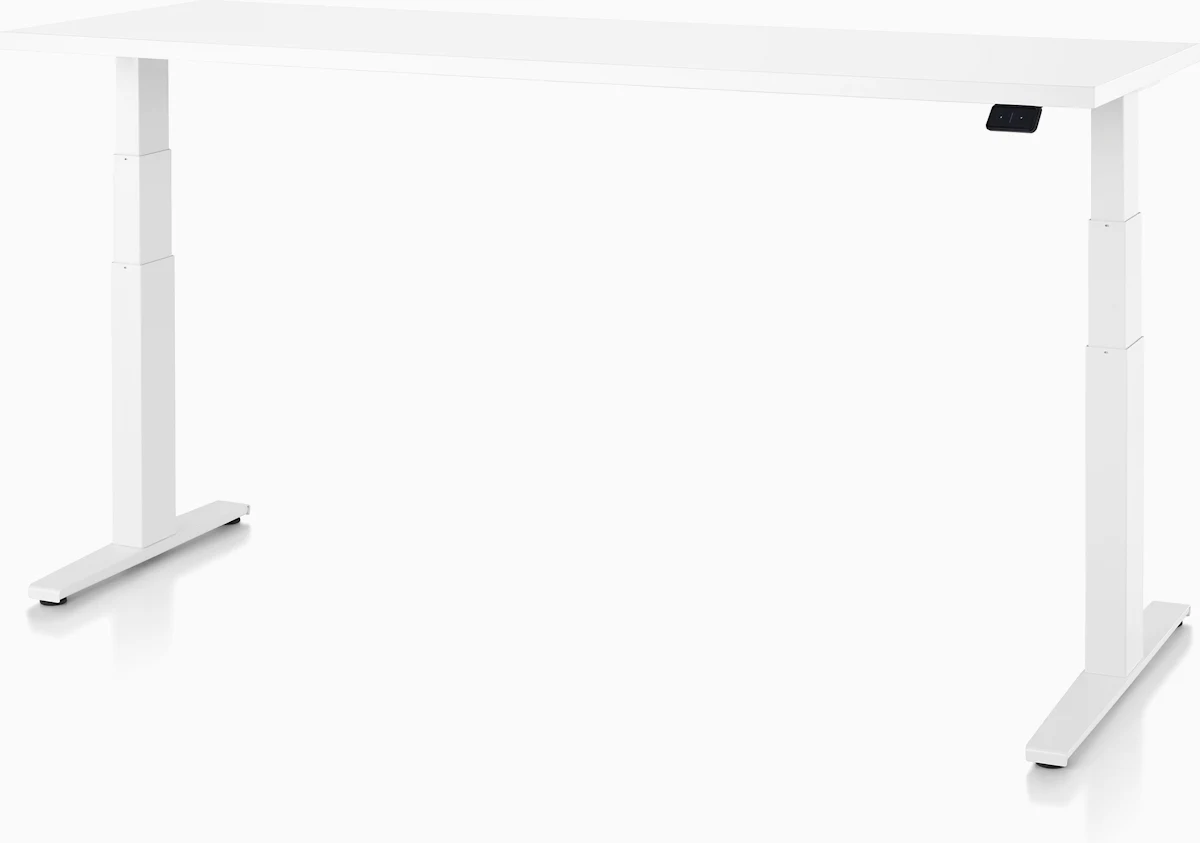
Herman Miller Motia Sit-to-Stand Desk
DEAS 7.8 out of 10
Two height ranges: Extended 22 to 48 inches, or Standard 27 to 46. BIFMA compliant, level certified, SCS Indoor Advantage Gold.
Commercial-grade build, with the certifications to back it: the top build and certification scores here. Choose the Extended base; the Standard one doesn't come down far enough for shorter people to sit at or go high enough for taller people to stand. The price is the honest trade-off.
Good: the top build and certification scores here; the Extended base covers 22 to 48 inches; a 12-year warranty on the contract specification. Less good: the lowest price score here, by far; capacity isn't published; too few consumer reviews for a reliability score.
Composite 7.8 on the DEAS (Desk Ergonomics Assessment Score). How we score
4 of 10. Strong all-rounder
Desky Dual Laminate Standing Desk
DEAS 7.7 out of 10
Dual motors; 23.6 to 49.2 inches without the top; 330.7-pound capacity. TÜV Rheinland and AFRDI certified.
A solid frame without obvious cost-cutting, with independent certification behind it. At full price it costs more than the E7 for a slightly lower score, so it's the one to buy on sale or if you prefer the brand.
Good: strong stability and clinical scores; a 330.7-pound capacity; a strong reliability score from user reviews; a 10-year frame and motor warranty. Less good: priced above the category benchmark; the top is covered for 5 years; ships in several boxes.
Composite 7.7 on the DEAS (Desk Ergonomics Assessment Score). How we score
5 of 10. Quickest to set up
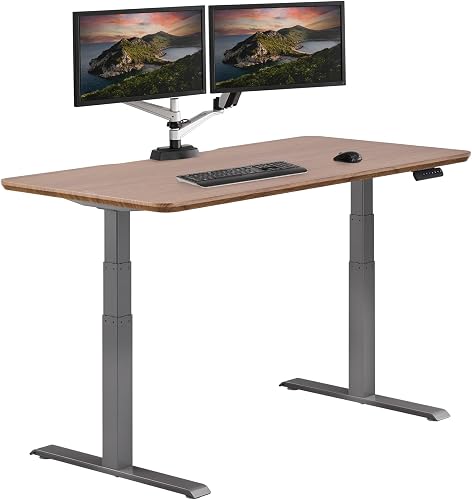
Vari Electric Standing Desk
DEAS 7.3 out of 10
25 to 50.5 inches; 200-pound capacity (60 by 30 inches). BIFMA, GREENGUARD Gold and UL962; lifetime warranty.
Vari's pitch is a desk that assembles in minutes, and its stability score is the second-best here. The price is the issue: it lands well above the category benchmark for what you get.
Good: the second-best stability score here; assembles in minutes; GREENGUARD Gold and BIFMA; a lifetime warranty. Less good: priced well above the category benchmark; its lowest height, 25 inches, is high for the shortest people.
Composite 7.3 on the DEAS (Desk Ergonomics Assessment Score). How we score
6 of 10. Best mid-price desk
Vernal Core3 Standing Desk
DEAS 7.1 out of 10
Dual motors; 23.9 to 49.4 inches without the top; 353-pound capacity; rated 48 dB. 15-year frame warranty.
A capable mid-price desk with a frame warranty as long as FlexiSpot's and more capacity than most here. A good choice if you'd rather not buy a FlexiSpot.
Good: a 15-year frame warranty; a 353-pound capacity; quiet motors; a fair price score. Less good: electrical parts and the top are covered for 5 years; lower stability and fit scores than the leaders.
Composite 7.1 on the DEAS (Desk Ergonomics Assessment Score). How we score
7 of 10. Best for small spaces
Branch Duo Standing Desk
DEAS 7.0 out of 10
Frameless, for more legroom; 28 to 47.3 inches; 275-pound capacity. BIFMA; 10-year warranty.
The frameless design gives you more legroom in a smaller footprint, and it looks at home outside an office. The narrow range is the catch: at 28 inches its lowest setting is too high for most people under about 5'10" to sit at, so check the chart first.
Good: frameless, with more legroom; BIFMA; a strong reliability score from user reviews; a 10-year warranty. Less good: its 28-inch lowest setting is too high for many people to sit at; two memory presets; priced above the category benchmark.
Composite 7.0 on the DEAS (Desk Ergonomics Assessment Score). How we score
8 of 10. Budget pick
Vari Essential Standing Desk
DEAS 6.9 out of 10
27.5 to 47.2 inches; 150-pound capacity; a two-piece top. UL tested to BIFMA standards; 3-year warranty.
A cheaper way into Vari's lineup that meets the bar for a light setup: a laptop and one monitor. The narrow range and lighter capacity are the trade-offs, and like the Branch Duo, it may not go low enough for shorter people to sit at.
Good: a good price score; tested to BIFMA standards; a strong reliability score from user reviews. Less good: a 150-pound capacity; a 3-year warranty; its 27.5-inch lowest setting is high for shorter people.
Composite 6.9 on the DEAS (Desk Ergonomics Assessment Score). How we score
9 of 10. Best from IKEA
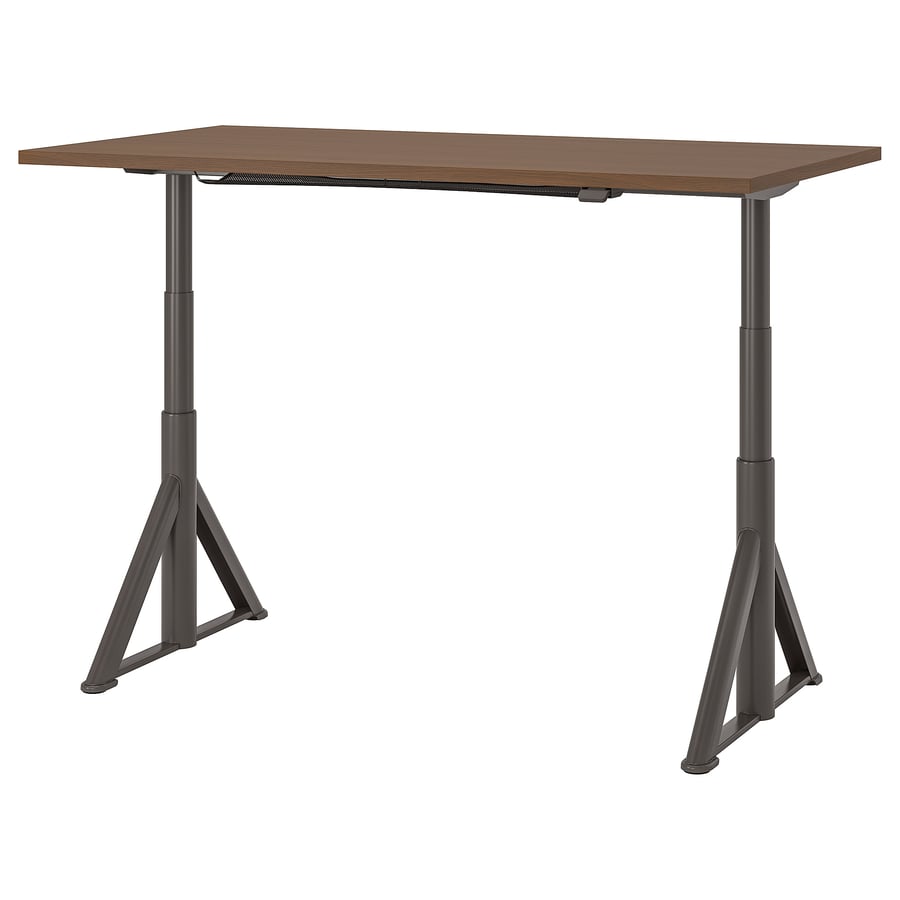
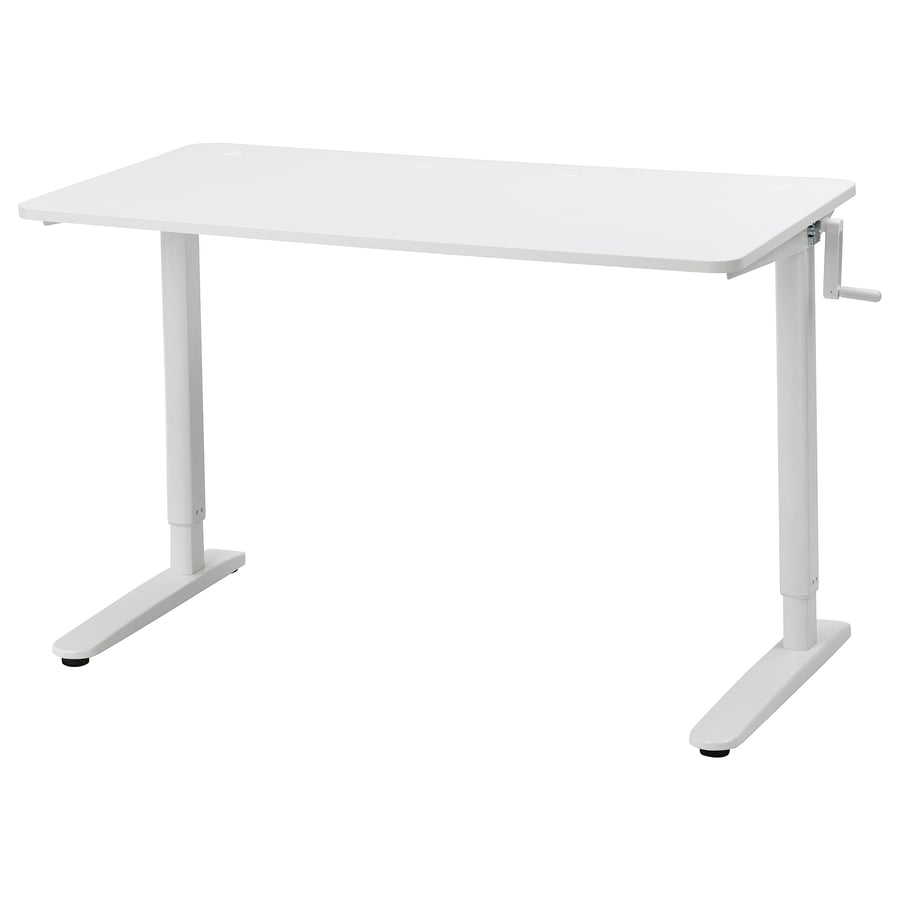
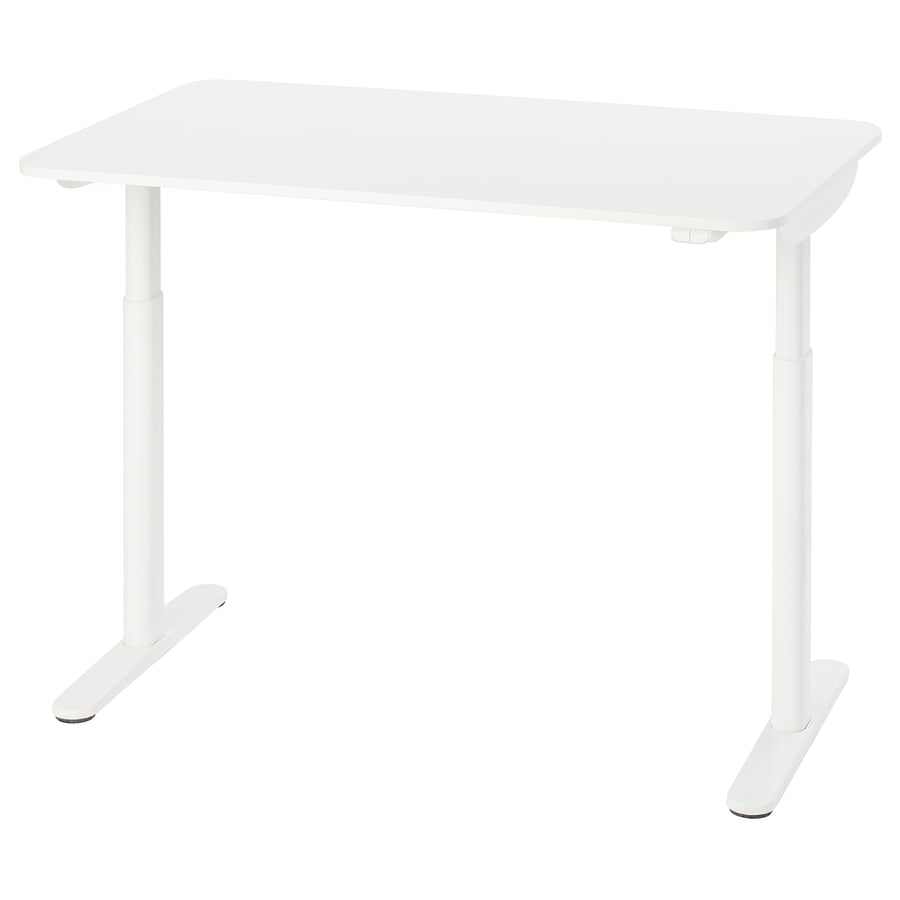
IKEA IDÅSEN Standing Desk
DEAS 6.8 out of 10
24.75 to 50 inches; 154-pound capacity; app control over Bluetooth. Tested to ANSI/BIFMA; 10-year warranty.
If you're an IKEA buyer who wants a real electric desk, this is the one in the lineup. The build is honest mid-tier, the range is wide, and the app is a nice touch.
Good: a wide 24.75- to 50-inch range; tested to ANSI/BIFMA; app control; a 10-year warranty. Less good: a 154-pound capacity, one of the lowest here; priced above the category benchmark.
Composite 6.8 on the DEAS (Desk Ergonomics Assessment Score). How we score
10 of 10. Solid runner-up
WorkPro Electric Standing Desk
DEAS 6.8 out of 10
A competent, middle-of-the-pack electric desk: its stability and clinical scores sit with the desks above it, its build score a little below. Check its height range against the chart before you buy.
Good: clinical and stability scores in line with the desks above it; a good reliability score from user reviews. Less good: priced above the category benchmark; a lower build score than the leaders.
Composite 6.8 on the DEAS (Desk Ergonomics Assessment Score). How we score
How to set up your standing desk
1
Set the sitting height first. Feet flat, forearms level, shoulders relaxed; the desktop meets your forearms. Save it as preset 1.
2
Set the standing height by your elbows. Arms relaxed, elbows bent about 90 degrees, keyboard at about elbow height.5 Save it as preset 2.
3
Raise the screen at both heights. Top edge level with your eyes, about an arm's length away. With bifocals, set it lower.6
4
Stand on a mat. A cushioned mat makes the standing part more comfortable.7
5
Alternate. Switch every 30 to 45 minutes. Start with about twenty minutes of standing at a time.
6
Recheck the presets now and then. A new chair or different shoes change both heights.
Clinical note
The desk can't fix the rest of the workstation. A chair without support, or a screen six inches too low, will still hurt at any desk height.
Which desk pain is a standing desk solving?
A dull lower-back ache from sitting
Feels like
Builds through the day and eases when you get up and walk around.
What helps
Switch positions through the day; standing for part of the afternoon breaks up the sitting.
Neck and upper-back tightness
Feels like
Tight across the base of the skull and the tops of the shoulders, worse as the day goes on.
What helps
Check the screen at both heights: top edge level with your eyes, sitting and standing.
Sore feet and heavy legs
Feels like
Burning feet and tired legs after standing a while.
What helps
Shorter standing bouts, a mat underfoot, and shift your weight.
Common questions
What is the best standing desk?
The FlexiSpot E7 Plus (DEAS 8.4): four legs and the steadiest frame we’ve scored. The FlexiSpot E7 (8.3) reaches from 22.8 to 48.4 inches, which covers sitting and standing for most people from about 5′0″ to 6′4″. The finder above checks the range against your height.
How does the fit finder work?
Tell it your height, whether you want a desk or a converter, and your budget. It works out the height your desk should be when you sit (at or just below your elbows) and when you stand, the same way the free assessment does, then picks the best-scored desk whose range covers both and whose top is at least 25 inches deep. The ranking below keeps only the desks that can.
What if a desk only reaches my standing height?
You can still sit at it: raise your chair until your elbows are level with the desk, and put a footrest under your feet. OSHA's guidance is feet flat on the floor or a footrest.9 The finder keeps only desks that reach both heights, because they need no workaround.
Do standing desks help?
Through the switching, not the standing. In a small four-week study, office workers given a sit-stand device sat about an hour a day less and reported 54% less upper back and neck pain, and most of the gains were gone within two weeks of the device being taken away.2 Alternate between sitting and standing; don't stand all day.
What is the DEAS score?
The Desk Ergonomics Assessment Score, Desk Doctor's product rating out of 10. Every product is scored on eleven dimensions in three layers: clinical performance, product quality and value. For desks, the category-specific part is height range and stability: whether it reaches the right heights for most people, sitting and standing, and whether it wobbles at full height. Tap any row in the ranking for the full breakdown. How we score.
How often is this ranking updated?
Scores are refreshed as products are revised and new models are scored. The ranking always reflects the current DEAS data.
Are these affiliate links?
Some are, which means Desk Doctor may earn a commission at no cost to you. Rankings are set by DEAS score alone and are never influenced by commissions.
What should I look for in a standing desk?
Start with the range: check the chart above for your two heights, and make sure the desk goes at least as low as the top of your sitting range and as high as your standing height. Then stability at full height, a warranty that covers the motor as well as the frame, a lift capacity with room for your monitors and any arm or tray, and memory presets, which you'll use every day.
Two legs or four?
Four legs spread the load over four points, which is why the E7 Plus has the top stability score here. A two-leg frame like the E7 is steady enough for most people with a normal setup; the difference shows at full height with a heavy load.
How long should I stand?
Less than you'd think, and never all day. An international expert statement suggests building up to 2 hours a day of standing and light activity during working hours, then 4,3 and prolonged standing has its own links to back and leg pain.4 I have people switch every 30 to 45 minutes, starting with about twenty minutes of standing at a time.
Do standing desks help with back pain?
Through the switching, not the standing. In a small four-week study, office workers given a sit-stand device sat about an hour a day less and reported 54% less upper back and neck pain, and most of the gains were gone within two weeks of the device being taken away.2 Older studies measured higher disc pressure sitting than standing, though newer ones haven't found a clear difference.8
Which desks didn't make the top 10?
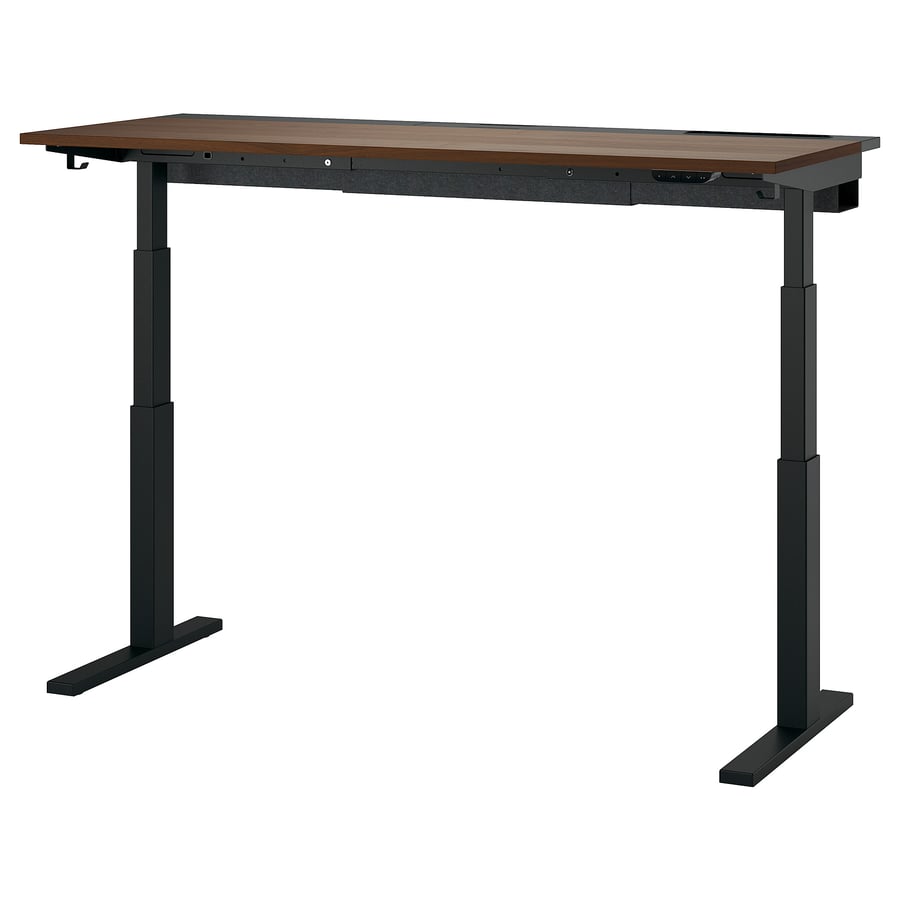
Nineteen more are in the ranking. Worth a look: the FlexiSpot E2 (6.7) if price comes first, though its 28-inch lowest height is too high for many shorter people; the IKEA MITTZON and Vernal Executive (both 6.7); the FlexiSpot E8 (6.6); and the Realspace Magellan (6.5), a pneumatic desk with no motor.
References
OSHA. Computer Workstations eTool: good working positions. osha.gov
Pronk NP, Katz AS, Lowry M, Payfer JR. Reducing occupational sitting time and improving worker health: the Take-a-Stand Project, 2011. Prev Chronic Dis. 2012;9:110323. doi:10.5888/pcd9.110323
Buckley JP, Hedge A, Yates T, et al. The sedentary office: an expert statement on the growing case for change towards better health and productivity. Br J Sports Med. 2015;49(21):1357–1362. PMID: 26034192. doi:10.1136/bjsports-2015-094618
Waters TR, Dick RB. Evidence of health risks associated with prolonged standing at work and intervention effectiveness. Rehabil Nurs. 2015;40(3):148–165. PMID: 25041875. doi:10.1002/rnj.166
Speed G, Harris K, Keegel T. The effect of cushioning materials on musculoskeletal discomfort and fatigue during prolonged standing at work: a systematic review. Appl Ergon. 2018;70:300–314. doi:10.1016/j.apergo.2018.02.021
Li JQ, Kwong WH, Chan YL, Kawabata M. Comparison of in vivo intradiscal pressure between sitting and standing in human lumbar spine: a systematic review and meta-analysis. Life. 2022;12(3):457. doi:10.3390/life12030457
This article is general education, not medical advice. If you have back, neck or leg pain that lasts, or pain, numbness or tingling down a leg, see a licensed clinician.
Healthcare Ergonomic Assessment Specialist. Conducts over a thousand workstation assessments a year across a multi-campus health system, and authored the DEAS standard used to rank every product on this site.
Diagnose your desk in 15 minutes.
The free assessment measures your setup against your body and names exactly what to change, what it costs, and what costs nothing.



 FlexiSpot E7 Plus Height 24–51.6″ 8.4 DEAS