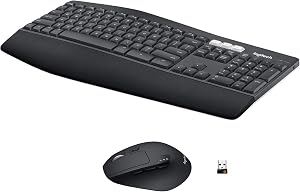
Short answer: the Cloud Nine C989M split is the best ergonomic keyboard we’ve scored, the Kinesis mWave is the best compact split, and the Logitech ERGO K860 is the easiest to switch to. The right style depends on where it hurts and your height: answer a few questions below and the finder picks yours.
Your pain decides the style, using the same ladder as the Desk Doctor assessment: your current keyboard with a palm support, then a basic ergonomic keyboard, a wave keyboard, a split keyboard, and an advanced (tented) split. The lowest step that suits your pain is marked Recommended; the steps above it are shown as Preventative.
Your height sets the closest-fit size, so the mouse doesn’t end up out past your shoulder: Compact (a number pad in a condensed layout) up to 5′5″, TKL (no number pad) from 5′6″ to 6′2″, and Full size from 6′3″. Size is partly preference, so you choose; number-pad users see Compact and Full.
Inside that style and size, the pick is the highest DEAS score. Fit comes before price: if nothing that fits is in your budget, the finder says so and shows the lowest-priced fit.
Why your keyboard is part of your wrist pain
When someone comes to me with wrist pain, forearm tightness or tingling fingers, the keyboard is one of the first things I check. A standard keyboard keeps both hands close together, so your wrists angle out toward your little fingers to reach the keys, and if its back feet are up, they bend back too. OSHA flags both.1
The fix is geometry. Split the keys and your wrists can line up with your forearms; tent them and your forearms don't have to lie flat; tilt the board away from you, or keep it flat, and your wrists stop bending back. Switches, macros and lighting are preferences.
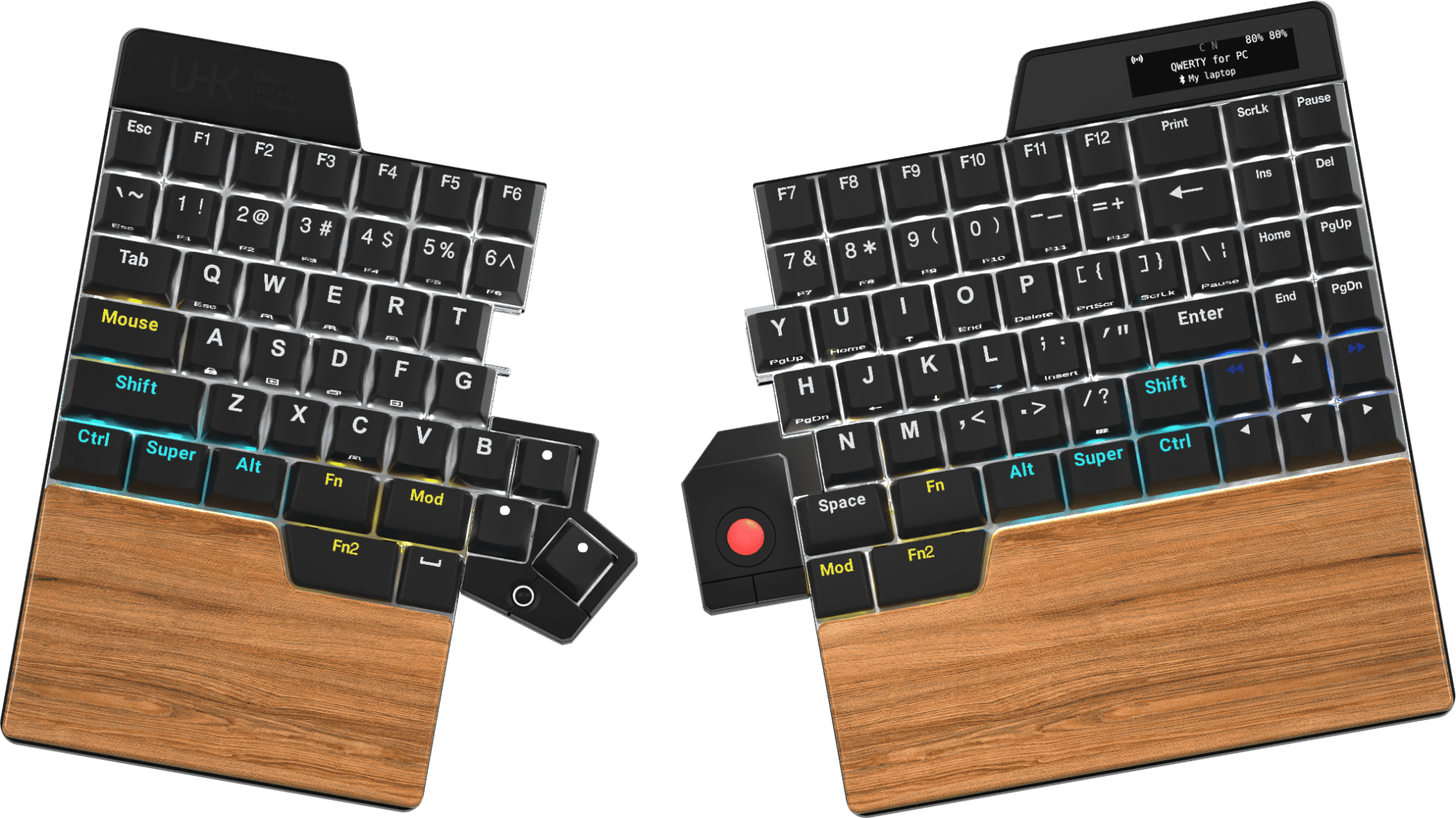
Of the 53 keyboards I scored, three tie at the top, and the Cloud Nine C989M is the one I'd start most people on. If you want the contoured design, buy the Kinesis Advantage360: the Advantage2 is being wound down.
Two wrist positions matter most: bent back, and bent sideways toward the little finger. OSHA's guidance is wrists straight and in line with your forearms, and it warns that a traditional keyboard can bend your wrists sideways and that raised keyboard feet can bend them up.1
What the research says
The angles matter because of the carpal tunnel. In healthy volunteers, about 33 degrees of wrist extension, or about 15 degrees of sideways bend toward the little finger, pushed carpal tunnel pressure over a common risk threshold in a quarter of them.2 In a lab comparison of six keyboard designs, the one that held wrists and forearms closest to neutral had a moderate fixed split of 12 degrees, a moderate tent of 14 degrees and no slope, though people typed fastest on the conventional keyboard they knew.3 Tilting the keyboard away from you straightens the wrist: in a typing study, a negative-slope support cut average wrist extension from 13 degrees to about –1.4
12° + 14°a moderate split and tent, with no slope: the design that kept wrists and forearms closest to neutral among six keyboards.3
13° → –1°average wrist extension when typing, without and with a negative-slope keyboard support.4
What that means when you shop
Even OSHA is careful here: these keyboards keep wrists closer to neutral, but the research hasn't shown they prevent discomfort or injury.1 Buy the shape your symptoms call for, then set it up well. Shopping for carpal tunnel? The best keyboard for carpal tunnel guide walks through it step by step.
Full reviews
1 of 10. Best overall
Cloud Nine C989M
DEAS 7.7 out of 10
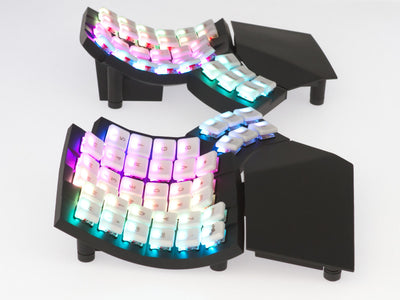
Two halves that separate up to 6 inches; a built-in 7-degree tent; full size with a number pad; Kailh Box mechanical switches; molded palm rests.
The keyboard I'd start most people on: a true split you can pull apart to your shoulder width, with a gentle built-in tent and palm rests, in a full-size layout with a number pad. It ties for our top score, and its price score is far better than the contoured keyboards'.
Good: halves that separate up to 6 inches; a number pad; mechanical switches; one of the best price scores here. Less good: the tent is fixed at 7 degrees; too few user reviews yet for a reliability score; no third-party certification.
Composite 7.7 on the DEAS (Desk Ergonomics Assessment Score). How we score
2 of 10. Best compact split
Kinesis mWave
DEAS 7.7 out of 10
One piece with a built-in split and tent; compact, no number pad; 5-degree negative tilt; washable palm rest; Gateron switches at 45 or 55 grams. 2-year warranty.
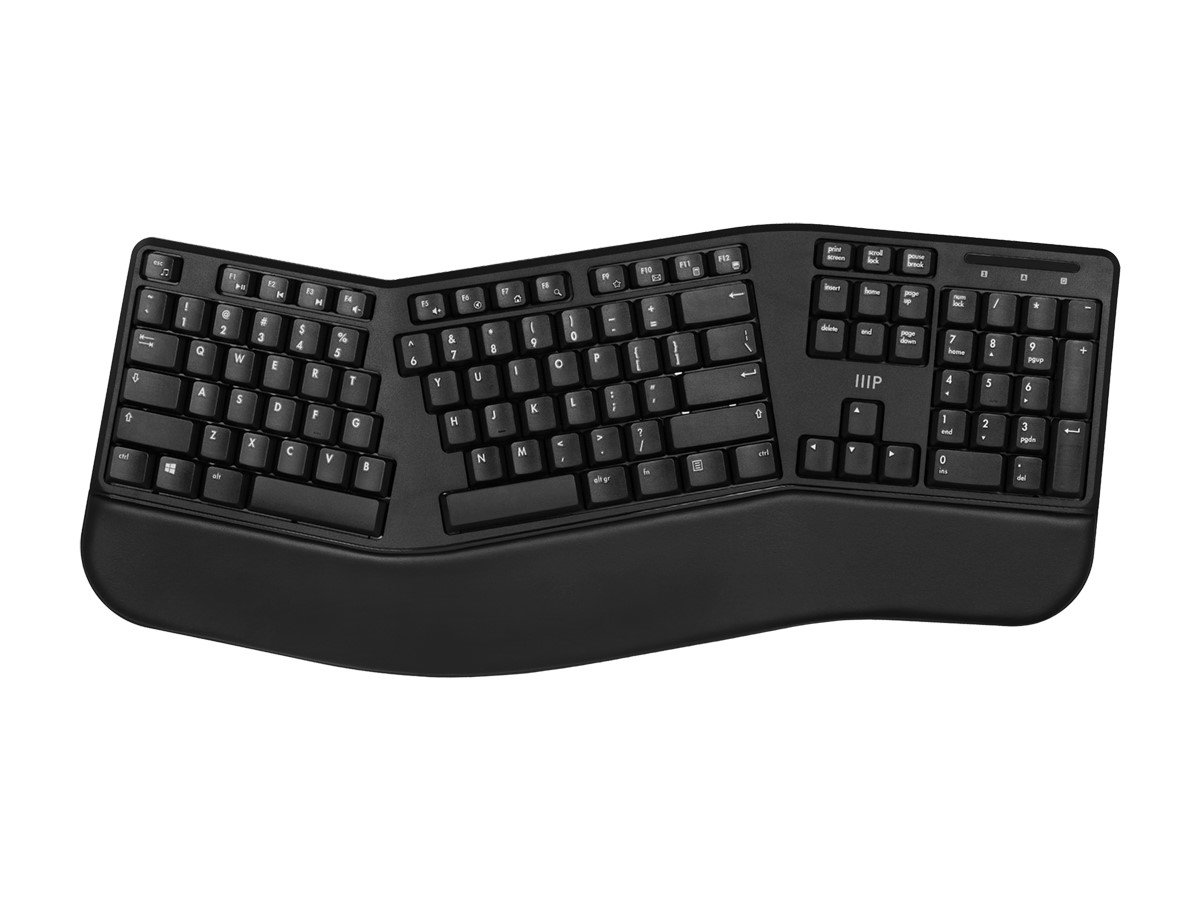
A compact split in one body: the keys are split and tented inside it, and with no number pad, your mouse sits closer to you. It ties with the C989M on every one of our scores, and it's the gentler step for most people.
Good: compact, so the mouse stays close; a built-in split, tent and negative tilt; a choice of light switches; a 2-year warranty. Less good: the split is fixed; too few user reviews yet for a reliability score.
Composite 7.7 on the DEAS (Desk Ergonomics Assessment Score). How we score
3 of 10. Contoured, while stocks last
Kinesis Advantage2
DEAS 7.7 out of 10
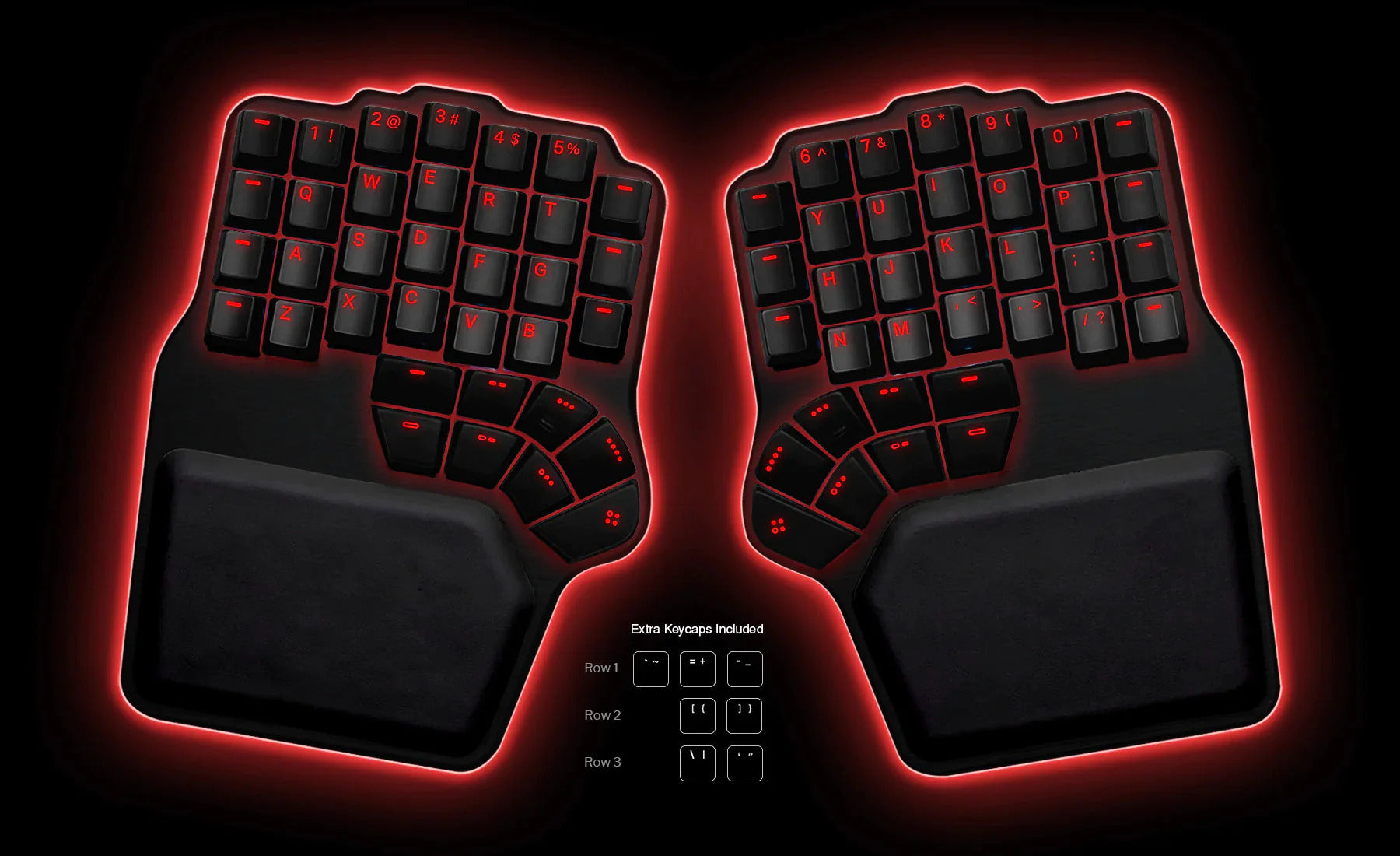
Two concave key wells tented at 20 degrees; thumb keys; no number pad; Cherry MX Brown switches at 45 grams; programs on the keyboard itself. 3-year warranty.
The contoured design puts each hand in its own bowl, tented 20 degrees, with the modifier keys moved under your thumbs. It ties for our top score. The catch: Kinesis announced in January 2026 that it's winding down production, so buy one while you can find it, or step to the Advantage360.
Good: concave key wells; modifier keys under your thumbs instead of your little fingers; light 45-gram switches; a 3-year warranty. Less good: production is winding down; priced well above the category benchmark; a real learning period.
Composite 7.7 on the DEAS (Desk Ergonomics Assessment Score). How we score
4 of 10. Best contoured keyboard
Kinesis Advantage360
DEAS 7.6 out of 10
Contoured key wells in two separate halves, 15.25 to 21.25 inches apart (wired); three tent settings; a wireless Pro version. 3-year warranty.
The contoured design split into two halves, so you can set them to your shoulder width and tent them at three heights. For broad shoulders, or anyone who wants contoured key wells without a fixed width, it's the one to buy now that the Advantage2 is winding down.
Good: fully separate halves for any shoulder width; three tent settings; a wireless version; a 3-year warranty. Less good: tied for the lowest price score here, from $499 at list; the same learning period as the Advantage2.
Composite 7.6 on the DEAS (Desk Ergonomics Assessment Score). How we score
5 of 10. Best wireless contoured
MoErgo Glove80
DEAS 7.6 out of 10
Two contoured halves with keys in columns; six thumb keys per hand; low-profile Kailh Choc switches; Bluetooth. 18-month warranty.
Contoured like the Advantage line but lower, 60 millimeters tall by MoErgo's measure, and wireless out of the box. The keys run in straight columns, so your fingers move up and down instead of on a diagonal. Expect a learning period.
Good: contoured and low-profile; wireless; six thumb keys per hand; open-source firmware. Less good: priced well above the category benchmark; an 18-month warranty; columns take getting used to.
Composite 7.6 on the DEAS (Desk Ergonomics Assessment Score). How we score
6 of 10. Most adjustable tent
Dygma Defy
DEAS 7.5 out of 10
Two separate halves with built-in tenting legs from 5 to 60 degrees, plus reverse tilt; keys in columns; eight thumb keys per half; hot-swap switches. 2-year warranty.
The widest tenting range here, from 5 to 60 degrees on built-in legs, plus reverse tilt, so you can find your angle and keep it. The keys run in columns, so give it a learning period; Dygma's Bazecor software handles remapping.
Good: tenting from 5 to 60 degrees; reverse tilt; hot-swap switches; magnetic palm pads; a 2-year warranty. Less good: tied for the lowest price score here; columns take getting used to.
Composite 7.5 on the DEAS (Desk Ergonomics Assessment Score). How we score
7 of 10. Best quiet mechanical split
Perixx PERIBOARD-835
DEAS 7.4 out of 10
One-piece split with a built-in palm rest; low-profile Kailh mechanical switches, brown and tactile; wired, 2.4 GHz or Bluetooth; legs tilt it to -4 or -7 degrees. 1-year warranty.
A one-piece split with quiet, low-profile mechanical switches, a built-in palm rest, and legs that tilt it away from you. It connects by cable, receiver or Bluetooth, and it shares the best reliability score from user reviews in our top ten.
Good: negative tilt built in; quiet tactile switches; four ways to connect; tied for the best reliability score from user reviews here. Less good: the split is fixed, with no tent; a 1-year warranty.
Composite 7.4 on the DEAS (Desk Ergonomics Assessment Score). How we score
8 of 10. Best low-profile split
R-Go Split Keyboard
DEAS 7.4 out of 10
Two fully separate halves; flat, light scissor keys like a laptop's; no palm rest.
Two separate halves with light, flat keys, close to typing on a laptop, so it's an easy switch if you like a shallow keyboard. There's no tent and no palm rest; pair it with a palm support if you rest your hands between bursts.
Good: fully separate halves; light, shallow keys; one of the best price scores here. Less good: no tent; no palm rest.
Composite 7.4 on the DEAS (Desk Ergonomics Assessment Score). How we score
9 of 10. Hardwood split
Keyboardio Model 100
DEAS 7.4 out of 10
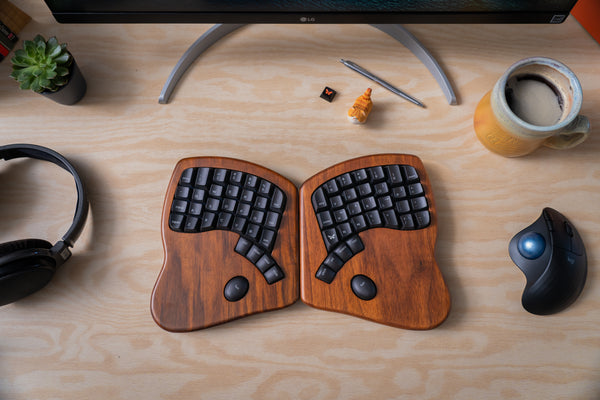
Two separate halves in a hardwood case (walnut, maple or cherry); 64 sculpted keycaps in columns; two palm keys; hot-swap switches; open-source firmware. 1-year warranty.
Two sculpted halves in a solid hardwood case, with keys in columns and two keys you press with the heels of your hands. It scores close to the contoured leaders on wrist position, and it's the keyboard people notice on your desk.
Good: sculpted keycaps; keys in columns; palm keys; hot-swap switches; open-source firmware. Less good: priced well above the category benchmark; a 1-year warranty; columns take getting used to.
Composite 7.4 on the DEAS (Desk Ergonomics Assessment Score). How we score
10 of 10. Easiest to switch to
Logitech ERGO K860
DEAS 7.3 out of 10
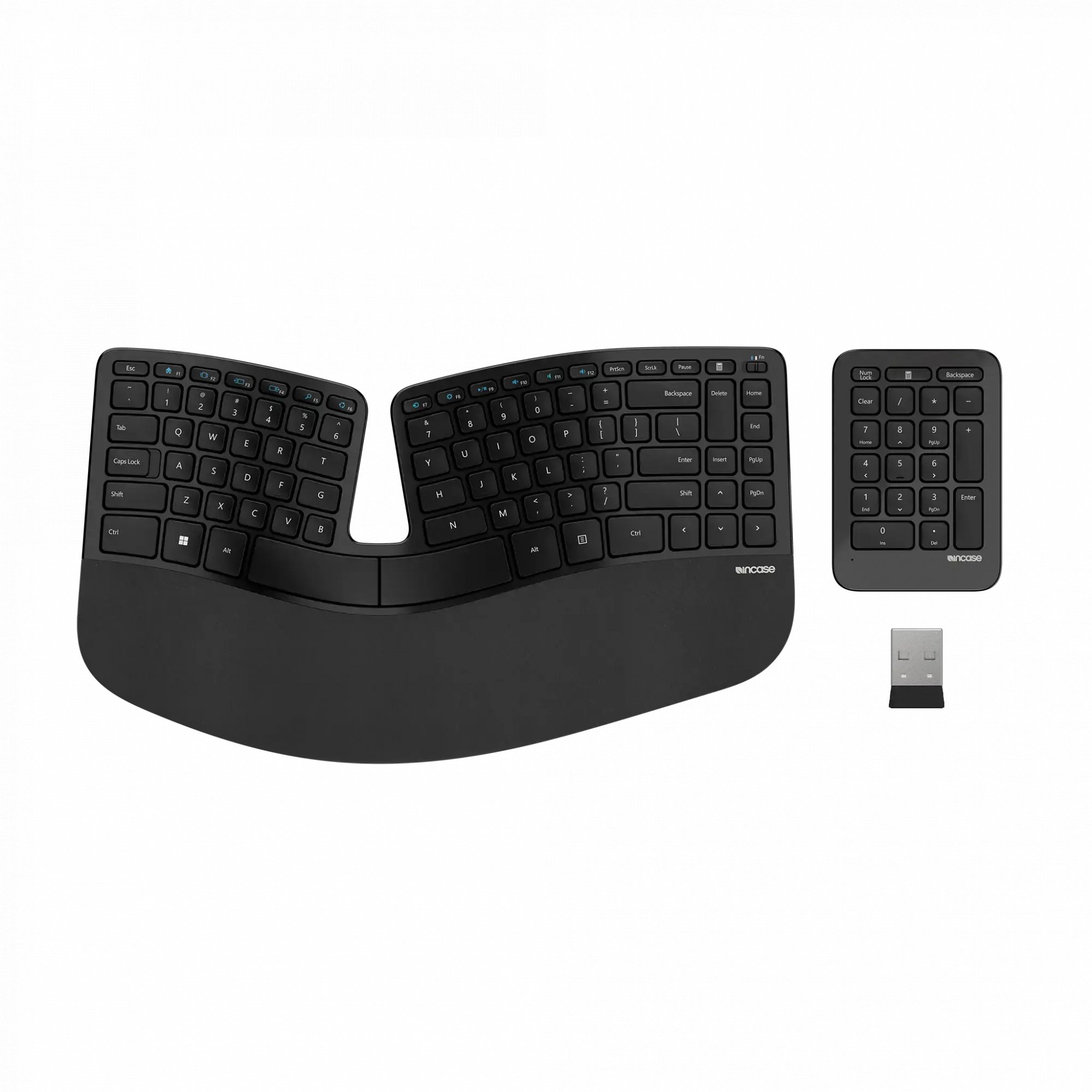
Curved one-piece split; full size with a number pad; front legs tilt it to -4 or -7 degrees; pillowed palm rest; pairs with up to 3 devices. 1-year warranty.
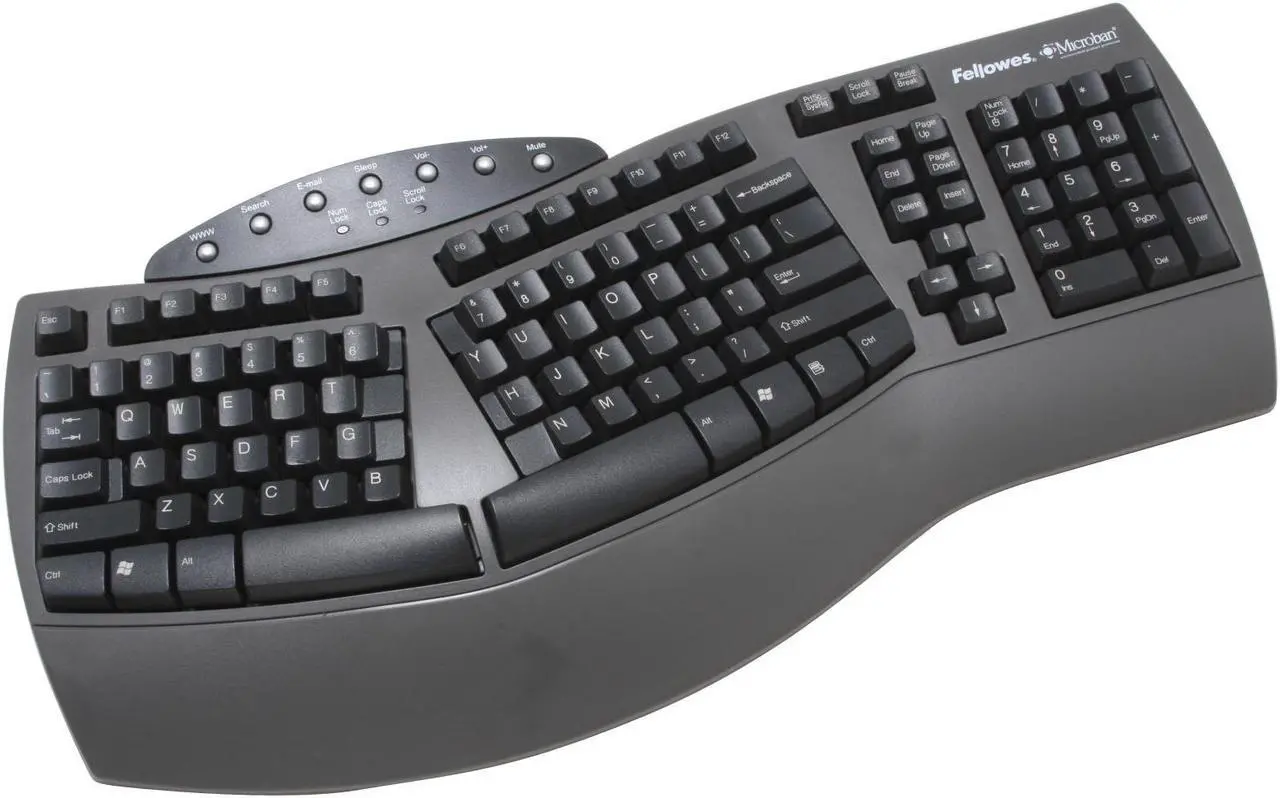
The gentlest step up from a flat keyboard: a standard layout, curved and split in one piece, with a cushioned palm rest and legs that tilt it away from you. Logitech says it's certified ergonomic by United States Ergonomics. When someone won't put up with a learning period, I start them here.
Good: a familiar layout; negative tilt; a number pad; three devices; one of the best price scores here. Less good: a fixed split with no tent; membrane keys; a 1-year warranty.
Composite 7.3 on the DEAS (Desk Ergonomics Assessment Score). How we score
How to set up your keyboard
1
Set your chair and desk first. Elbows about level with the keyboard and hanging by your sides, shoulders relaxed.1 No keyboard fixes a desk that is too high.
2
Put it directly in front of you. Center the gap between the halves, or the B key, on your body, close enough that your elbows stay by your sides.1
3
Fold the back feet away. Use them only if they keep your wrists straight; flat, or tilted slightly away from you, is better.1,4
4
Set the split and tent gradually. Halves about shoulder width apart, so your wrists line up with your forearms. Start with a low tent and raise it if it feels right.
5
Keep the mouse close. Right beside the keyboard, as OSHA advises.5
6
Hover while you type. Rest the heel of your palm on the palm rest between bursts, not your wrist, and not while you type.6
7
Give it time. OSHA notes you may need time to get used to these keyboards,1 and in a learning-curve study, typists quickly regained the speed they lost on a split and a contoured keyboard.7
Clinical note
If your speed still hasn't come back after a few weeks, the keyboard may be wrong for your hands or your work, not the idea of a split.
Which keyboard pain are you solving?
Tingling thumb and fingers
Feels like
Numbness or tingling in the thumb, index and middle fingers, often at night or after a long typing day.
What helps
Keep the wrists straight: feet folded, a flat or negative tilt, and hover while you type. A contoured keyboard like the Advantage360 is the top step if that isn't enough.
Pain on the little-finger side of the wrist
Feels like
An ache along the outer edge of the wrist, worse after long typing.
What helps
A split. Even a gentle one, like the K860, lets your wrists line up with your forearms.
Tight shoulders and upper back
Feels like
Rounded shoulders and a knot between the shoulder blades by the afternoon.
What helps
Pull the keyboard close and set separate halves, like the C989M's, to your shoulder width.
Common questions
What is the best ergonomic keyboard?
The Cloud Nine C989M (DEAS 7.7), a split you pull apart to shoulder width, with a number pad. Without a number pad, the Kinesis mWave (7.7); easiest to switch to, the Logitech ERGO K860 (7.3). The finder above matches the style to your symptoms and frame.
Which keyboard style should I choose?
Work up a ladder, gentlest first: your own keyboard with a palm support, a basic ergonomic keyboard, a wave, a split, then an advanced split, with fully separate or sculpted halves. Higher steps straighten your wrists more and take longer to learn. The assessment picks your starting step from how much, and how often, your wrists and elbows hurt: mild wrist pain alone starts at the bottom; the more your elbows join in, and the worse both get, the higher it starts. OSHA backs these keyboards for neutral wrists, though the research hasn't shown they prevent discomfort or injury.1
What keyboard size do I need?
One sized to your frame. A narrower keyboard lets the mouse sit closer to your body, and OSHA notes that a mouse kept close to the keyboard cuts down on repeated reaching.1 The assessment's rule, which the finder above uses: compact under 5'6", tenkeyless (no number pad) from 5'6" to 6'2", and full size from 6'3".
Are split keyboards hard to get used to?
There's a learning period, and OSHA says to expect one.1 It's shorter than most people fear: in a learning-curve study of 16 typists, the speed they lost on a fixed split keyboard and on a contoured split one came back quickly.7 Even so, don't jump to an advanced split if a gentler step would do.
What is the DEAS score?
The Desk Ergonomics Assessment Score, Desk Doctor's product rating out of 10. Every product is scored on eleven dimensions in three layers: clinical performance, product quality and value. For keyboards, the category-specific part is wrist neutral and key actuation: whether the shape keeps your wrists straight (split, tented and negative-tilt designs score higher), and whether the keys take a light press. Tap any row in the ranking for the full breakdown. How we score.
How often is this ranking updated?
Scores are refreshed as products are revised and new models are scored. The ranking always reflects the current DEAS data.
Are these affiliate links?
Some are, which means Desk Doctor may earn a commission at no cost to you. Rankings are set by DEAS score alone and are never influenced by commissions.
How long does it take to get used to a split keyboard?
There's a learning period, and OSHA says to expect one.1 It's shorter than most people fear: in a learning-curve study of 16 typists, the speed they lost on a fixed split keyboard and on a contoured split one came back quickly.7 In my experience, keys in columns, like the Glove80's, take longer than a standard layout that's simply split.
Do I need a mechanical keyboard?
No. The shape is what straightens your wrists; switch type is preference. If your fingers tire, a lighter switch can feel easier: the Advantage2 uses 45-gram switches, and the mWave comes with 45 or 55.
Will an ergonomic keyboard prevent wrist pain?
It lowers the strain, but nobody can promise prevention. OSHA's own summary is that these keyboards help keep wrists neutral, but the research doesn't show they prevent discomfort or injury.1 Setup matters as much as shape: wrists straight, elbows by your sides, the mouse close.
Keir PJ, Bach JM, Hudes M, Rempel DM. Guidelines for wrist posture based on carpal tunnel pressure thresholds. Hum Factors. 2007;49(1):88–99. PMID: 17315846. PubMed
Rempel D, Barr A, Brafman D, Young E. The effect of six keyboard designs on wrist and forearm postures. Appl Ergon. 2007;38(3):293–298. PMID: 16806042. doi:10.1016/j.apergo.2006.05.001
Hedge A, Powers JR. Wrist postures while keyboarding: effects of a negative slope keyboard system and full motion forearm supports. Ergonomics. 1995;38(3):508–517. PMID: 7729392. doi:10.1080/00140139508925122
Anderson AM, Mirka GA, Joines SMB, Kaber DB. Analysis of alternative keyboards using learning curves. Hum Factors. 2009;51(1):35–45. PMID: 19634307. CDC Stacks
This article is general education, not medical advice. If you have wrist, hand or elbow pain, numbness or tingling that lasts, see a licensed clinician.
Healthcare Ergonomic Assessment Specialist. Conducts over a thousand workstation assessments a year across a multi-campus health system, and authored the DEAS standard used to rank every product on this site.
Not sure it’s the keyboard?
The free assessment checks your whole desk against your body in 15 minutes and names exactly what to change, what it costs, and what costs nothing.




 Cloud Nine C989M Ergonomic Mechanical Keyboard Full size Advanced split 7.7 DEAS