Short answer: the Humanscale FR300 Foot Rocker is the best footrest we’ve scored, the ErgoFoam Adjustable Foot Rest is nearly as good for a fraction of the price, and for a high desk the Safco Task Master reaches 15 inches. Whether you need one, and how tall, depends on your height and your desk: enter both below and the finder works it out, the same way the free assessment does.
Your desk should sit at or just below your elbows. When it’s higher than that, the fix that keeps the desk is to raise your seat until your elbows are level with it, and that lifts your feet off the floor. The footrest makes up the gap. These are the numbers the Desk Doctor assessment uses: seated elbow height about 39% of your height, seat height about a quarter.
The finder works out that gap for your height and desk, gives it as a two-inch window, and keeps the footrests that adjust into it. If your desk is already at elbow height, you don’t need one, and it says so. If your desk is too low, a footrest won’t help, and it says that too.
The pick is the highest DEAS score that reaches your window. Fit comes before price: if nothing that reaches is in your budget, the finder says so and shows the lowest-priced one that does.
Why the gap under your feet matters
If your feet dangle, you tuck them under the chair, or the front of the seat digs into your thighs by mid-afternoon, the problem usually isn't the chair. Your seat is set too high for your legs, usually to meet a desk that's too high for you, and nothing closed the gap underneath.
It's one of the most common things I see in assessments, and one of the cheapest to fix. With your feet unsupported you either slide forward to reach the floor, which takes your back off the backrest, or let the front edge of the seat carry your legs. OSHA's guidance is feet flat on the floor or on a footrest, and it notes a footrest can lift the knee slightly to take pressure off the back of the leg.1
The 20 I scored fall into two camps: rigid, height-adjustable rockers that cost real money, and foam blocks that are comfortable and cheap but adjust less. There's a right answer in both.
A seat set high enough for your elbows to meet the desk is often too high for your feet to reach the floor. OSHA's guidance describes what happens next: a seat that's too high can leave your feet unsupported, or slide you forward in the chair until your back is off the backrest. Its fix is a footrest whenever the seat can't come down without putting the keyboard or monitor too high.1
How high it should be
High enough that your whole foot is supported and your thighs sit about level, with the front edge of the seat no longer pressing behind your knees. OSHA's working-posture guidance puts the thighs about horizontal and the lower legs about vertical when you sit upright.2 The finder on our footrest ranking works out the height from your height and desk height, the same way the free assessment does.
What that means when you shop
Measure the gap first, then buy a footrest whose height covers it. Height matters more than anything else on the spec sheet; tilt, rocking and a firm surface come after.
Full reviews
1 of 10. Best overall
Humanscale FR300 Foot Rocker
DEAS 7.1 out of 10
Height 3.75 to 6.75 inches; rocks on ball-bearing rollers. A hardwood platform on a steel frame.
This is the footrest I reach for first. Three inches of height adjustment covers the gap most shorter people are dealing with, and the platform rocks, so your ankles keep moving instead of locking up. It has the top score here.
Good: the top score here; 3.75 to 6.75 inches of height; rocks smoothly; tied for the top build score; a 15-year warranty. Less good: priced well above the category benchmark; a low certification score; the rocking takes a day or two to get used to.
Composite 7.1 on the DEAS (Desk Ergonomics Assessment Score). How we score
2 of 10. Best fixed-height rocker
Humanscale FR500 Foot Rocker
DEAS 7.0 out of 10
A fixed 4.5 inches; rocks on curved aluminum legs. A molded plywood platform, 16.75 by 12.25 inches.
The FR300's fixed-height sibling, rocking on curved legs instead of rollers. I recommend it only when you already know about 4.5 inches is your gap, so measure first.
Good: a rocking platform with nothing to adjust or loosen; tied for the top build score; a 15-year warranty. Less good: one height only, 4.5 inches; priced well above the category benchmark.
Composite 7.0 on the DEAS (Desk Ergonomics Assessment Score). How we score
3 of 10. Best value
ErgoFoam Adjustable Foot Rest
DEAS 7.0 out of 10
High-density foam with two heights, about 4 or 6 inches with the lifter. Flips over to rock.
The one I point most people to when they want to buy without overthinking it. It scores almost level with the Humanscale rockers, the FR300 and FR500, for a fraction of the price, gives you two heights, and flips over into a rocker.
Good: nearly the top score at a much lower price; two heights; flips over to rock; a strong reliability score from user reviews. Less good: only two heights; no tilt; a low certification score.
Composite 7.0 on the DEAS (Desk Ergonomics Assessment Score). How we score
4 of 10. Best budget adjustable
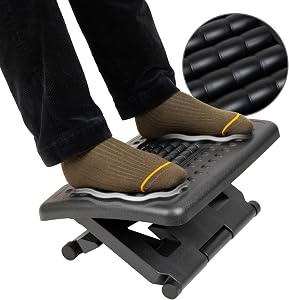
HUANUO Adjustable Footrest
DEAS 6.5 out of 10
Three heights from about 4 to 6.5 inches; tilts 0 to 30°. An 18 by 13-inch plastic platform.
Height and tilt adjustment for very little money. It won't feel as solid underfoot as the picks above, but it gets your feet planted at the angle you want, which is the whole job.
Good: height and tilt adjustment; a big 18 by 13-inch platform; one of the best price scores; a strong reliability score from user reviews. Less good: a lighter plastic build; a low certification score.
Composite 6.5 on the DEAS (Desk Ergonomics Assessment Score). How we score
5 of 10. Office standard
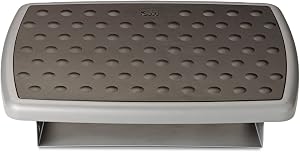
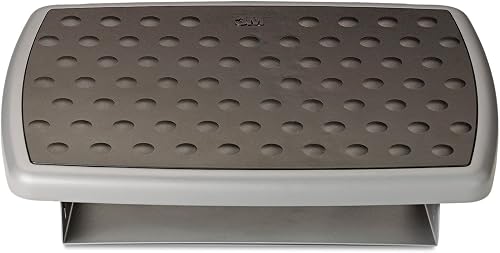
3M Adjustable Footrest (FR330)
DEAS 6.5 out of 10
About 4 to 5 inches high; the platform rocks under tension you set. 18 by 13 inches.
The footrest you've seen under a hundred office desks, and it earns that: simple, dependable and fairly priced. The height range is narrow, so it suits a small gap, and the platform rocks under tension you set rather than locking at an angle.
Good: a proven office design; adjustable rocking tension; a strong price score. Less good: only about an inch of height range; the tilt doesn't lock; a 2-year warranty.
Composite 6.5 on the DEAS (Desk Ergonomics Assessment Score). How we score
6 of 10. Best for high desks
Safco Task Master Footrest (5124)
DEAS 6.5 out of 10
5.5 to 15 inches in nine positions, the tallest range here. A steel platform at a fixed 8° angle.
If you sit at a counter-height desk, or a standing desk you keep high, this is the footrest that reaches: up to 15 inches. It also has the top injury-reduction score here and ties for the top build score. The catch is the price.
Good: the tallest range here, up to 15 inches; the top injury-reduction score; the best certification score here; a lifetime warranty. Less good: priced further above the category benchmark than any footrest here; the angle is fixed at 8°; heavier than the foam picks at 12 pounds.
Composite 6.5 on the DEAS (Desk Ergonomics Assessment Score). How we score
7 of 10. Best for restless feet
UPLIFT Desk Foot Hammock
DEAS 6.3 out of 10
A canvas foot hammock that hangs from the underside of the desk; the strap loop adjusts from about 11 to 23.5 inches.
Not a platform but a hammock: it hangs under the desk and lets your feet swing and shift. It's a comfort-and-movement aid rather than a precise fix for a height gap, so match it to that job. Take the canvas off and the wood bars work as a simple footrest.
Good: keeps your feet moving; fits almost any desk height; a strong build score; a 15-year warranty. Less good: no stable platform, so it won't hold your feet at a set height; rated to 50 pounds when hung from the desk; priced above the category benchmark.
Composite 6.3 on the DEAS (Desk Ergonomics Assessment Score). How we score
8 of 10. Softest feel
Everlasting Comfort Memory Foam Foot Rest
DEAS 6.2 out of 10
Memory foam, 17 by 9.5 by 4.75 inches. Flips over to rock.
The comfort-first pick: a soft memory-foam block that feels good underfoot and flips over into a gentle rocker. It works if its height suits your gap; the soft foam gives a little under your feet.
Good: soft and comfortable; flips into a rocker; one of the best price scores; a strong reliability score from user reviews. Less good: one height; soft foam gives under load; a low adjustability score.
Composite 6.2 on the DEAS (Desk Ergonomics Assessment Score). How we score
10 of 10. Contoured foam
Cushion Lab Ergonomic Footrest
DEAS 6.1 out of 10
Contoured memory foam with massage ridges, 17 by 10.5 by 5 inches.
A denser, contoured take on the foam footrest, with ridges along the top. If about 5 inches is your gap and you want a comfortable fixed platform, it's a good pick.
Good: contoured foam with massage ridges; good posture-support scores for a foam footrest; a fair price. Less good: one height, 5 inches; it doesn't rock or tilt.
Composite 6.1 on the DEAS (Desk Ergonomics Assessment Score). How we score
11 of 10. Two-height foam
ComfiLife Memory Foam Foot Rest
DEAS 6.0 out of 10
High-density memory foam in two pieces: use it with or without the base for two heights. Washable cover.
A comfortable foam footrest with a removable base, so you get two heights instead of one, and a cover you can wash. A good, inexpensive way to close a small gap.
Good: two heights; a washable cover; one of the best price scores; a strong reliability score from user reviews. Less good: soft foam gives under load; a low adjustability score.
Composite 6.0 on the DEAS (Desk Ergonomics Assessment Score). How we score
How to set up your footrest
1
Set the chair for your arms first. Elbows level with the desk, shoulders relaxed. Never lower the chair just to reach the floor.
2
Sit back. Back against the backrest. The gap between your feet and the floor now is what the footrest fills.
3
Set the height. Whole foot supported, thighs about level, knees bent about 90 degrees.
4
Check the seat edge. If it still presses behind your knees, raise the footrest a little.
5
Set the tilt, if it has one. Ankles relaxed, not pointed sharply up or down.
6
Keep the whole sole on it. If only your toes or heels touch, the angle or height is wrong.
One more thing
A footrest is support, not a place to prop your feet at an extreme angle. It should let you shift position naturally through the day.
Which footrest helps which problem?
Aching or tingling thighs
Feels like
An ache or pins and needles along the backs of the thighs that builds through the afternoon.
What helps
Raise your feet until the seat edge stops pressing behind your knees. A height-adjustable footrest makes that easy.
A tired lower back
Feels like
Fine in the morning, slumped by midday, because you've been sliding forward to reach the floor.
What helps
Close the gap so you can sit back against the backrest.
Stiff, restless ankles
Feels like
Ankles feel locked and legs feel heavy from sitting still.
What helps
A rocking footrest, like the FR300, or one that flips over to rock, gives your feet something to do.
Common questions
What is the best footrest for under a desk?
The Humanscale FR300 Foot Rocker (DEAS 7.1): three inches of height adjustment and a platform that rocks. The ErgoFoam Adjustable Foot Rest (7.0) is nearly as good for a fraction of the price, and the Safco Task Master reaches 15 inches for high desks. The finder above checks which one reaches the height you need.
Do I need a footrest?
You need one if, once your seat is high enough for your elbows to meet the desk, your feet no longer rest flat on the floor. That's common for shorter people and at fixed-height desks. OSHA's guidance is feet flat on the floor or a footrest, and a footrest when the seat can't come down without leaving the keyboard too high.1 Put your height and desk height into the finder above: it tells you, the same way the free assessment does, and gives the height to set it to.
Fixed or adjustable height?
A fixed footrest works if you know the height you need and it matches. An adjustable one is safer if you're not sure, change shoes or share the desk. The finder gives your height range and keeps the footrests that reach it.
What is the DEAS score?
The Desk Ergonomics Assessment Score, Desk Doctor's product rating out of 10. Every product is scored on eleven dimensions in three layers: clinical performance, product quality and value. For footrests, the category-specific part is knee angle and contact pressure: whether it brings your knees to a comfortable angle, and spreads the pressure under your feet without hard spots. Tap any row in the ranking for the full breakdown. How we score.
How often is this ranking updated?
Scores are refreshed as products are revised and new models are scored. The ranking always reflects the current DEAS data.
Are these affiliate links?
Some are, which means Desk Doctor may earn a commission at no cost to you. Rankings are set by DEAS score alone and are never influenced by commissions.
What should I look for in a footrest?
Height first. Measure the gap between your feet and the floor once your chair is set, then pick a footrest whose height covers it; buying a fixed height that doesn't match is the most common mistake. After that: tilt, so your ankles sit relaxed; a platform big enough for both feet; a surface firm enough not to sag; and rocking, if you like your feet moving.
Do I need a footrest, or should I lower my chair?
Lowering the chair to reach the floor puts the desk above your elbows, and your arms reach up all day. Set the seat so your elbows meet the desk, then close the gap under your feet. That's OSHA's advice too: a footrest when the seat can't come down without leaving the keyboard too high.1 If your feet rest flat with your elbows at desk height, you don't need one.
Rocking or flat?
They do different jobs. A flat, height-adjustable platform holds your feet at the right height and keeps them there. A rocker keeps your ankles moving, which some people find eases the stiffness of sitting still. If your problem is dangling feet, start with height; if you sit very still and your ankles feel locked, a rocker earns its place.
Will a footrest fix a chair with no lumbar support?
No. A footrest closes the gap under your feet, which helps you sit back instead of sliding forward. It can't replace a chair that doesn't support your lower back. If your chair has no usable lumbar support, fix that too.
Which footrests didn't make the top 10?
Ten more are in the ranking. The best of them, the BlissTrends Dual Layer, scores 6.0, level with the ComfiLife. The Eureka in ninth place isn't reviewed: the listing we scored is a rolling stool 16.7 to 20.2 inches tall, far taller than a desk footrest needs to be.
Healthcare Ergonomic Assessment Specialist. Conducts over a thousand workstation assessments a year across a multi-campus health system, and authored the DEAS standard used to rank every product on this site.
Diagnose your desk in 15 minutes.
The free assessment measures your setup against your body and names exactly what to change, what it costs, and what costs nothing.




 Humanscale FR300 Foot Rocker Height 3.75–6.75″ 7.1 DEAS